10 Jun 2015 — Ethan Jacobs
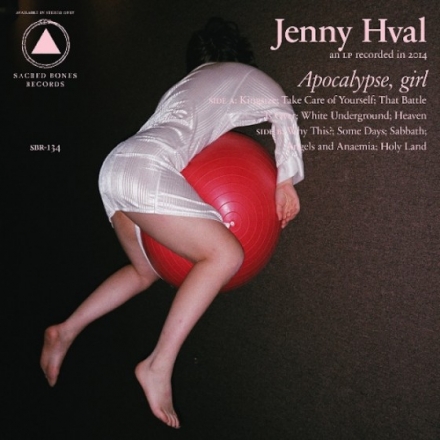
On the opening track of Jenny Hval’s second full-length release Apocalypse Girl, the Norwegian singer quotes the Danish poet Mette Moestrup. “Think. Big. Girl. Like King. Think. Kingsize,” Hval punches with a soft whisper, enunciating the final consonant of each word so that you can almost hear the flicks of her tongue. The track is like a confessional overview of the album, sprinkled with jarring phrases that Hval pronounces carefully like “soft dick rock” over a backdrop of discordant, bending samples. While the word “kingsize” might inspire associations with the super-size-me mentality of the United States, the word here is more akin to Hval’s zoomed out, big-picture approach with the record. Even with softened, broader themes and more open space, her meditations have never been more poignant.
This may be Jenny Hval's second proper LP, but she has been making music since she was 19 when she joined a goth band called Shelly’s Raven (they couldn’t use Shelly’s Crow because it was too similar to Sheryl Crow). She eventually left the group to record her own music under the moniker Rockettothesky for her first two albums, which mostly gained traction in her native Norway. 2013’s Innocence is Kinky was her first eponymous release, whose critical praise more officially made a name for Hval’s brand of sample heavy, nonconforming pop music that guides blindly through spaces with smart and disarmingly confrontational lyrics. Although the soundscapes of each of Hval’s releases vary, her fascination with language and her ability to use it as a device of confrontation always remains central. On Apocalypse, her command of words allows her to explore broader themes like spirituality and death that she avoided in her previous records.
The last time Hval toured, her frustration with shoddy sound systems at various venues gave way to the erratic explosions of sound and fuzz on her 2013 release. The accompanying lyrics, via some form of mimicry, assumed a predatory, active function. Innocence deliberately objectified the human body using shallow definitions of language: The album begins with Hval saying, “That night I watched people fucking on my computer.” Apocalypse Girl boasts the same amount of profanity in its lyrics, but the record more clearly capitalizes on Hval’s desire to create the softer, more emotional music that she deviated from on Innocence. Tracks like “Why This_” and “Heaven” are more sentimental simply because they are quieter pop songs, each element easily traced back to Hval’s aim to create spacious tracks.
With more afforded space for fragile emotion, her crude lyrics explore sexuality as something expansive and natural rather than further exploiting Innocence’s emphasis on a lustful, animalistic notion. For example the recurring comparison of the soft dick and a banana dissolves the sexual connotation of the penis as well as its association with power and success. By softening up (literally) and zooming out, Apocalypse Girl directs more attention to Hval’s intelligent lyricism, especially when it comes to sex and gender. “And when I touched you, I turned you into a girl, only for a moment,” Hval coos over a backdrop of soaring synths and gentle harp plucking on “Angels and Anaemia.” It’s not that Hval hasn’t tackled the issue of gender on her other records, but Apocalypse’s overarching quiet inspires more profound introspection than her other releases. The record leaves space for tender emotions and deep thought, which makes the pictures she paints more vivid and her own experiences more accessible.
Hval may have quieted down on Apocalypse, but her hypnotically shrill and crystalline vocals remain integral, especially when you consider the words they’re responsible for. In “That Battle is Over” Hval’s repetition of “heaven” is so piercing that it sounds like glass could shatter. It’s all very purposeful, though: Hval puts a sharp inflection on certain words and thickly enunciates syllables as if she wants you to hear them echoing in your head after the song is over. Her words resonate the most on Apocalypse because they are impactful in the album’s stiller environments. She’s can’t be easily figured out, but her zoomed out perspective on this album better shows us the bigger picture she was looking at.
Apocalypse Girl is out now via Sacred Bones. Continue reading for the interview.
Read more →