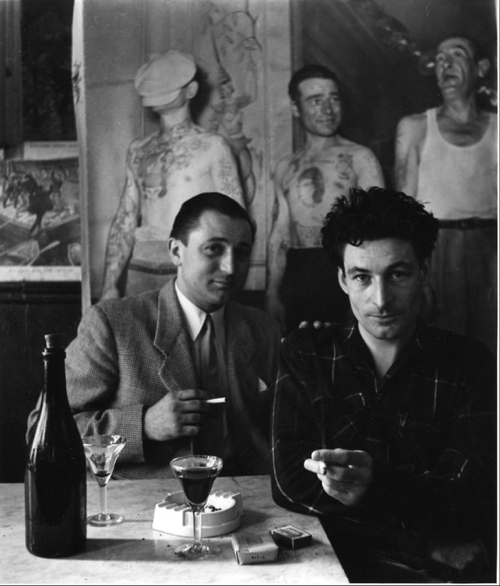
Fresh as a daisy, HVYWTR (pronounced Heavy Water) is the brand new project initiated by WG (Wolfgang Nessel) and VC (Vic Cheong), formerly of the now sadly defunct Toronto deranged disco glam purveyor and NNF/100% Silk alumni The Deeep, together with Doc Dunn and Jonathan Adjemian (of One Hundred Dollars fame). There's not a lot of material yet, but the slowly meandering nine and a half minute synth jam "Got Soul" (that actually sounds like it comprises quite a few improvised passages) instantly got me. The tune will be on a forthcoming HVYWTR tape on WG's own Healing Power Records.
Read more →
Fresh as a daisy, HVYWTR (pronounced Heavy Water) is the brand new project initiated by WG (Wolfgang Nessel) and VC (Vic Cheong), formerly of the now sadly defunct Toronto deranged disco glam purveyor and NNF/100% Silk alumni The Deeep, together with Doc Dunn and Jonathan Adjemian (of One Hundred Dollars fame). There's not a lot of material yet, but the slowly meandering nine and a half minute synth jam "Got Soul" (that actually sounds like it comprises quite a few improvised passages) instantly got me. The tune will be on a forthcoming HVYWTR tape on WG's own Healing Power Records.
Our favorite synth-wiz Bernardino Femminielli returns with this heavy piece of "Karaoke Nouvel-Âge", marvelously visualized by Sabrina Ratté with this breathtaking ten minute excursion into the unknown business of retro-futurist entertaining. The song itself was recorded as a four-piece, an approach that definitely pays off, as "Atlantida" is by all means another creative leap forward for Montréal's most exciting Italo-synth renegade.
"Atlantida" will be part of a forthcoming tape on Robert & Leopold, due sometime in November.
Femminielli - AtlantidaRead more →
Our favorite synth-wiz Bernardino Femminielli returns with this heavy piece of "Karaoke Nouvel-Âge", marvelously visualized by Sabrina Ratté with this breathtaking ten minute excursion into the unknown business of retro-futurist entertaining. The song itself was recorded as a four-piece, an approach that definitely pays off, as "Atlantida" is by all means another creative leap forward for Montréal's most exciting Italo-synth renegade.
"Atlantida" will be part of a forthcoming tape on Robert & Leopold, due sometime in November.
Femminielli - Atlantida
With his brand new collaboration track with folk musician Owensie (on vocals), the Dublin based magician Darragh Nolan aka Sacred Animals never ceases to amaze us. Hidden behind a blurry wall of haunting melodies, Michael Owens vocals vocals bathe in a darker and more mysterious sound than I recall from Darragh's earlier works, particularly when compared to his far more poppy Welcome Home EP. In fact, "Cat and Mouse" might be a little in the direction of Darragh's upcoming debut album (which he is in the process of recording); a sound he unveils will be more spacier and organic, as well as "sparse in places but with rushes of harmony", as he wrote to me on facebook chat.
The video for the track was recorded and edited within a few days by Feel Good Lost (Brendan Canty) whom, after listening to the track, literally ran outside with his cam recorder in the night to catch that particular eery atmosphere he was looking for.
While waiting for the final Sacred Animals full-lenght to drop (it might take a while, Darragh emphasizes), he apparently have a few collaborations going on with rising dream pop craftsman Sun Glitters, as well as LA native House of Wolves. Stay tuned.
With his brand new collaboration track with folk musician Owensie (on vocals), the Dublin based magician Darragh Nolan aka Sacred Animals never ceases to amaze us. Hidden behind a blurry wall of haunting melodies, Michael Owens vocals vocals bathe in a darker and more mysterious sound than I recall from Darragh's earlier works, particularly when compared to his far more poppy Welcome Home EP. In fact, "Cat and Mouse" might be a little in the direction of Darragh's upcoming debut album (which he is in the process of recording); a sound he unveils will be more spacier and organic, as well as "sparse in places but with rushes of harmony", as he wrote to me on facebook chat.
The video for the track was recorded and edited within a few days by Feel Good Lost (Brendan Canty) whom, after listening to the track, literally ran outside with his cam recorder in the night to catch that particular eery atmosphere he was looking for.
While waiting for the final Sacred Animals full-lenght to drop (it might take a while, Darragh emphasizes), he apparently have a few collaborations going on with rising dream pop craftsman Sun Glitters, as well as LA native House of Wolves. Stay tuned.
Although the tendency to fall for trite, romanticist pastiche is always only a step away in Germany, I've felt that hauntology as an artistic concept has never really gained a foothold in the local experimental underground (as opposed to fine art, a point convincingly made by Adam Harper in reference to Neo Rauch). Considering this, I was both very surprised and quite intrigued to come across the latest offering by Frankfurt-based cassette imprint SicSic Tapes, a C-40 split between Johannes Schebler aka Baldruin and Christian Schoppik, who records under the moniker Brannten Schnüre. In fact it was the latter's side of the tape that really grabbed my attention. Brannten Schnüre's six tracks (that can all be streamed over here) deliver a disturbing if not outright frightening séance made up of looped, slowly meandering instrumental sound collages that feature a good deal of crackling and tape hiss (most likely because the snippets were directly taken from an audio or video cassette). However, what struck me most was Schoppik's choice of source material. As it turns out (according to the description given by the label), he derived a lot of (most?) samples from "obscure Czechoslovakian films", a method that in my view deserves a closer look in regard to the condition of possibility of a "genuine" hauntology in the domestic music scene. Brannten Schnüre - Gole Gandom Let's consider how the use of early electronic music taken from the BBC Radiophonic Workshop etc. by Mordant Music and the Ghost Box label led Mark Fisher and Simon Reynolds to first come up with a description of hauntology as a musical concept (I'll leave it that way, others have described it way better), i.e. music that was mainly used to score 60s to 80s educational programmes and the like. And then let's also look at what induced David Keenan to give birth to hypnagogic pop in 2009, a "genre" that's in many ways related and by some regarded as the American counterpart to hauntology, namely the exploitation of the all-American canon of 80s pop culture, from early MTV videos to all kinds of TV series by h-pop's main proponents such as James Ferraro). Considering this, I find it a very interesting question to ask what would be the appropriate source for a likewise inspired compatriot to come up with a similar piece of art (I admit that I haven't asked myself this question before, which probably says more about my personal relationship to the music of this country that about the music scene itself). Now it seems to me that Schoppik might have found a very compelling, indeed intriguing answer. Trying to remember my earliest childhood, it indeed appears that we've been raised on things like Arabela or Tři oříšky pro Popelku (Three Nuts for Cinderella), or briefly, fairly cheesy fairytale movies and TV series that were produced in Prague's famous Barrandov Studios. More precisely, at least this was the main cultural influence druing our 80s childhoods (apart from Astrid Lindgren adaptations perhaps) that was not derived from or exposed to the prevalent Anglo-American culture (needless to say, this observation is non-judgmental). So I'd argue that if there's anything like the possibility of an original hauntology as a musical concept in Germany or other countries of Central Europe, it would be built on such source material that was used by Schoppik for Brannten Schnüre, or anything similar, and this is what makes his release truly noteworthy. The music's hauntological effect gets further reinforced with the accompanying video for "Gole Gandom", in which the artist uses exactly the esthetic these productions were famous for (unfortunately I couldn't confirm that the footage is actually taken from a Czechoslovak movie, but it definitely fits their general esthetic and it appears to match the timeframe as well). Don't know what this film was about, but at least the editing leaves quite a terrifying impression:The (highly recommended) split tape may be ordered directly via SicSic Tapes. Schoppik takes the concept further with his work "Zaharia Farâmas Protokoll in sechs Teilen" (protocol in six parts), in fact the only other piece of music I've found by him, and of which "Gole Gandom" actually constitutes the last (i.e. sixth) part. Zaharia Farâmas is the protagonist of the 1967 novella Pe strada Mântuleasa (The Old Man and the Bureaucrats) by the (rather controversial, but we need not elaborate this here) Romanian author Mircea Eliade. Farâmas, an elderly school teacher, gets caught by the Securitate (secret police) and subsequently interrogated. The communist officials (thus being representatives of a regime that at least formally pursues the path of Europe's last true utopian philosophical concept) then get mesmerized by the teacher as he starts telling fabulous, labyrinthine stories from the past. Eliade later stated that he (quite obviously) attempted to "engineer a confrontation between two mythologies: the mythology of folklore, of the people, which is still alive, still welling up in the old man, and the mythology of the modern world, of technocracy". This is of course not only postmodern, post-utopian. Moreover, if we accept that hauntology "doesn't merely show or recall an image of the past, [but] shows the present – or more specifically, (...) the past as it exists and is perceived from inside the present", and that "hauntological art is a present-day construction that illustrates the present’s problems as it approaches the future" (again Harper), then what Schoppik does here by using samples from our faintly remembered childhoods and by establishing a connection between the musical result and Eliade's story is a pronouncedly hauntological project, and one that is not a pale imitation of its British or - provided we accept to include hypnagogic pop - American counterparts but that is distinctly, originally Central European (if not exclusively German).Zaharia Farâmas Protokoll in sechs Teilen by branntenschnuere
Read more →
Although the tendency to fall for trite, romanticist pastiche is always only a step away in Germany, I've felt that hauntology as an artistic concept has never really gained a foothold in the local experimental underground (as opposed to fine art, a point convincingly made by Adam Harper in reference to Neo Rauch). Considering this, I was both very surprised and quite intrigued to come across the latest offering by Frankfurt-based cassette imprint SicSic Tapes, a C-40 split between Johannes Schebler aka Baldruin and Christian Schoppik, who records under the moniker Brannten Schnüre. In fact it was the latter's side of the tape that really grabbed my attention. Brannten Schnüre's six tracks (that can all be streamed over here) deliver a disturbing if not outright frightening séance made up of looped, slowly meandering instrumental sound collages that feature a good deal of crackling and tape hiss (most likely because the snippets were directly taken from an audio or video cassette). However, what struck me most was Schoppik's choice of source material. As it turns out (according to the description given by the label), he derived a lot of (most?) samples from "obscure Czechoslovakian films", a method that in my view deserves a closer look in regard to the condition of possibility of a "genuine" hauntology in the domestic music scene. Brannten Schnüre - Gole Gandom Let's consider how the use of early electronic music taken from the BBC Radiophonic Workshop etc. by Mordant Music and the Ghost Box label led Mark Fisher and Simon Reynolds to first come up with a description of hauntology as a musical concept (I'll leave it that way, others have described it way better), i.e. music that was mainly used to score 60s to 80s educational programmes and the like. And then let's also look at what induced David Keenan to give birth to hypnagogic pop in 2009, a "genre" that's in many ways related and by some regarded as the American counterpart to hauntology, namely the exploitation of the all-American canon of 80s pop culture, from early MTV videos to all kinds of TV series by h-pop's main proponents such as James Ferraro). Considering this, I find it a very interesting question to ask what would be the appropriate source for a likewise inspired compatriot to come up with a similar piece of art (I admit that I haven't asked myself this question before, which probably says more about my personal relationship to the music of this country that about the music scene itself). Now it seems to me that Schoppik might have found a very compelling, indeed intriguing answer. Trying to remember my earliest childhood, it indeed appears that we've been raised on things like Arabela or Tři oříšky pro Popelku (Three Nuts for Cinderella), or briefly, fairly cheesy fairytale movies and TV series that were produced in Prague's famous Barrandov Studios. More precisely, at least this was the main cultural influence druing our 80s childhoods (apart from Astrid Lindgren adaptations perhaps) that was not derived from or exposed to the prevalent Anglo-American culture (needless to say, this observation is non-judgmental). So I'd argue that if there's anything like the possibility of an original hauntology as a musical concept in Germany or other countries of Central Europe, it would be built on such source material that was used by Schoppik for Brannten Schnüre, or anything similar, and this is what makes his release truly noteworthy. The music's hauntological effect gets further reinforced with the accompanying video for "Gole Gandom", in which the artist uses exactly the esthetic these productions were famous for (unfortunately I couldn't confirm that the footage is actually taken from a Czechoslovak movie, but it definitely fits their general esthetic and it appears to match the timeframe as well). Don't know what this film was about, but at least the editing leaves quite a terrifying impression:The (highly recommended) split tape may be ordered directly via SicSic Tapes. Schoppik takes the concept further with his work "Zaharia Farâmas Protokoll in sechs Teilen" (protocol in six parts), in fact the only other piece of music I've found by him, and of which "Gole Gandom" actually constitutes the last (i.e. sixth) part. Zaharia Farâmas is the protagonist of the 1967 novella Pe strada Mântuleasa (The Old Man and the Bureaucrats) by the (rather controversial, but we need not elaborate this here) Romanian author Mircea Eliade. Farâmas, an elderly school teacher, gets caught by the Securitate (secret police) and subsequently interrogated. The communist officials (thus being representatives of a regime that at least formally pursues the path of Europe's last true utopian philosophical concept) then get mesmerized by the teacher as he starts telling fabulous, labyrinthine stories from the past. Eliade later stated that he (quite obviously) attempted to "engineer a confrontation between two mythologies: the mythology of folklore, of the people, which is still alive, still welling up in the old man, and the mythology of the modern world, of technocracy". This is of course not only postmodern, post-utopian. Moreover, if we accept that hauntology "doesn't merely show or recall an image of the past, [but] shows the present – or more specifically, (...) the past as it exists and is perceived from inside the present", and that "hauntological art is a present-day construction that illustrates the present’s problems as it approaches the future" (again Harper), then what Schoppik does here by using samples from our faintly remembered childhoods and by establishing a connection between the musical result and Eliade's story is a pronouncedly hauntological project, and one that is not a pale imitation of its British or - provided we accept to include hypnagogic pop - American counterparts but that is distinctly, originally Central European (if not exclusively German).Zaharia Farâmas Protokoll in sechs Teilen by branntenschnuere
Mysterious Athens, Greece one-man project A Victim Of Society returns with another eerie, gloomy tune that's strangely upbeat, to be placed somewhere close to 50s rock'n'roll heyday with a few subtle cold wave influences. I have to say I'm becoming quite a fan of that distant, rasping voice of his. Really great track, hope there's gonna be a proper release anytime soon.
Read more →
Mysterious Athens, Greece one-man project A Victim Of Society returns with another eerie, gloomy tune that's strangely upbeat, to be placed somewhere close to 50s rock'n'roll heyday with a few subtle cold wave influences. I have to say I'm becoming quite a fan of that distant, rasping voice of his. Really great track, hope there's gonna be a proper release anytime soon.
Here's the first cut from Xander Harris' forthcoming "science fiction concept release Chrysalid, out sometime soon on Pour Le Corps Records. A little less upbeat than the acclaimed Urban Gothic (Not Nof Fun) perhaps, but still in a very decent Carpenter-esque mode.
Read more →
Here's the first cut from Xander Harris' forthcoming "science fiction concept release Chrysalid, out sometime soon on Pour Le Corps Records. A little less upbeat than the acclaimed Urban Gothic (Not Nof Fun) perhaps, but still in a very decent Carpenter-esque mode.
Readers of this blog will be aware that for us, the visualization of a song is almost as essential as the music itself, especially since these days there's a whole lot of immensely talented video artists out there, resulting in an overwhelming amount of new videos each week. Some of them we'll post here and write about, others will land on our Facebook page or our tumblr, while others will be missed completely. However, as we don't have time to say meaningful things about every awesome video but both agree that a lot more videos deserve to get up here, today we launch our new weekly feature Video Sunday, which from now on will showcase up to six videos selected by us, usually from the just bygone week. No words, just love - we hope you enjoy:
Pressed And - Raid (by Nathaniel Whitcomb)
Dirty Beaches - Lone Runner (by Kevin Luna)
Sandro Perri - Love and Light (by Pedro Maia)
Good Sport – Pushover (by Geoff Hoskinson)
Napolian - Hoobangin '96 (Blue Wrangler Sport) (by Heather Palmer)
Eola - Ancient Hill (by Eola)
Read more →
Readers of this blog will be aware that for us, the visualization of a song is almost as essential as the music itself, especially since these days there's a whole lot of immensely talented video artists out there, resulting in an overwhelming amount of new videos each week. Some of them we'll post here and write about, others will land on our Facebook page or our tumblr, while others will be missed completely. However, as we don't have time to say meaningful things about every awesome video but both agree that a lot more videos deserve to get up here, today we launch our new weekly feature Video Sunday, which from now on will showcase up to six videos selected by us, usually from the just bygone week. No words, just love - we hope you enjoy:
Pressed And - Raid (by Nathaniel Whitcomb)
Dirty Beaches - Lone Runner (by Kevin Luna)
Sandro Perri - Love and Light (by Pedro Maia)
Good Sport – Pushover (by Geoff Hoskinson)
Napolian - Hoobangin '96 (Blue Wrangler Sport) (by Heather Palmer)
Eola - Ancient Hill (by Eola)
For our fourth NFOP session, we were invited to Gothenburg by the Swedish pop outfit Slutet, whom we also wrote about earlier this fall. The session was recorded in a graveyard near the city centre — which obviously was a fitting setting to the acoustic version of the song they played, "The Funeral Party". Check it out below.
Read more →
For our fourth NFOP session, we were invited to Gothenburg by the Swedish pop outfit Slutet, whom we also wrote about earlier this fall. The session was recorded in a graveyard near the city centre — which obviously was a fitting setting to the acoustic version of the song they played, "The Funeral Party". Check it out below.




 Our favorite synth-wiz Bernardino Femminielli returns with this heavy piece of "Karaoke Nouvel-Âge", marvelously visualized by Sabrina Ratté with this breathtaking ten minute excursion into the unknown business of retro-futurist entertaining. The song itself was recorded as a four-piece, an approach that definitely pays off, as "Atlantida" is by all means another creative leap forward for Montréal's most exciting Italo-synth renegade.
"Atlantida" will be part of a forthcoming tape on Robert & Leopold, due sometime in November.
Femminielli - Atlantida
Read more →
Our favorite synth-wiz Bernardino Femminielli returns with this heavy piece of "Karaoke Nouvel-Âge", marvelously visualized by Sabrina Ratté with this breathtaking ten minute excursion into the unknown business of retro-futurist entertaining. The song itself was recorded as a four-piece, an approach that definitely pays off, as "Atlantida" is by all means another creative leap forward for Montréal's most exciting Italo-synth renegade.
"Atlantida" will be part of a forthcoming tape on Robert & Leopold, due sometime in November.
Femminielli - Atlantida
Read more →