


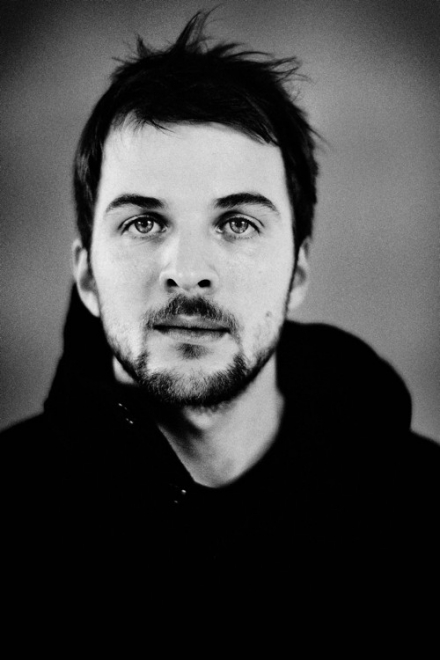
Interview: Nils Frahm
21 Mar 2014 — Lukas Dubro
While watching Nils Frahm perform, it’s clear that the musician from Berlin devotes all of himself to his work. Crouched over his keys, his body moves to the rhythm of his music with his lips pursed in concentration. One moment he is sitting on front of his piano, the next, he’s turning buttons on his effects units or playing a line on his synthesizer. Most of time, a lot is happening at once. The sweat always runs.
Frahm works with the same intensity beyond the stage. Before shows he puts up his own lights and soundchecks for as long as four hours. His recordings are a testament to the investment of time in both composition and production. Still, when he does have free time, he works to maintain a studio where he knows every single knob and screw. It is the same studio he’s done most of the work on his ten albums since 2005. Equally impressive is the list of his collaborations; over the last few years he’s worked with Ólafur Arnalds, Anne Müller and Peter Broderick.
His commitment paid off. Frahm is one of the most celebrated German musicians of our time. We visited the artist at home a week after his show at Radialsystem in Berlin. As you might expect, Frahm gave 100 percent. Despite his demanding schedule, he gave us plenty of time to ask all of our questions. Before the interview he made some espresso; afterwards, bread and cheese. In between, it felt like visiting an old friend. Nonetheless, the real highlight of the day was viewing his famous home studio.
This is it, the spaceship. Makes me a bit uncomfortable.
Uncomfortable! Why?
Depends on who is coming, of course, but most people feel overwhelmed [by the studio]. They don't understand what I’m doing here. But I like it when someone commits to something and becomes an expert-- no matter if it's kayaks, canoes or stamps.
Do you know a lot of people like this?
Yes. Matthias, for example, is helping me take care of the studio. He’s a total nerd. He knows everything between 1920 and 1950. He can explain to you exactly what instruments there were, how they worked and who used them. We both think that this time was the golden era of sound recording. People used less tracks, but every single one had better quality. The same goes with every part. We are experimenting a lot with stuff from that time. We unscrew them, exchange parts and maintain them. The studio is our Klanglabor (sound laboratory).
When did you start collecting instruments?
When I was 12. My first piece was a Fender Rhodes piano, a friend of mine showed it to me. Next was a Moog and then a Juno. That was the beginning, and I never wanted to use anything else again.
Where did you find all these instruments?
Sometimes I read the back of my favorite vinyl records. They’ll have studio photos...then I connect to internet, type in the name and see what comes up. And what I’ll find is a small shop somewhere in Tennessee whose owner put up a photo online. I’ll call him up and talk to him until he realizes that I’m like him. We’ll become friends and he’ll tell me that he knows somebody who might help me.
And what draws you to gear specifically?
I always liked artists that worked hard every day. And I always saw myself as a craftsman. I can't write a song every day, I’m not creative enough. Still, I want to have something to do. So when I’m not feeling inspired, I’ll work on my studio. It’s like meditation. It keeps my life in motion.
Are you ever afraid you’ll neglect the music?
There are different phases-- times when I’ll work meticulously on my studio and times that I have to tell myself to stop. When I’m recording I recognize that it’s valuable to put so much time into my gear, because I can put up four microphones, press the record button and have it sound finished. Jazz musicians from the ‘40s and ‘50s did the same thing. They were able to record their albums within two days because everything was ready for it.
So it’s about creating the right setting?
Exactly! I try to create an environment where things can happen. It's the greatest part of my work and it's what makes me proud at the end of the day. Chord progressions don’t matter as much for me. What’s more important is the sound and how it comes across, how the details are treated. Those are the things that matter.
Noted. Then how do you feel about people making music on their laptops?
It’s a tendency that I don't like. I think things shouldn't be too easy. The industry is always looking for new ways to make things easier. But that’s very dangerous, because people will be coddled and become lazy. They’ll get used to the fact that you could do an expensive sounding album for 2,000 Euro. I know the people that are running studios, buying expensive instruments, and they really know their stuff. They should be in charge. That would be good for music.
And what about the people who get on stage with nothing but their laptop?
This trend concerns me. Concerts are the last pillar of the music industry. It will fall if these people keep bringing only their laptops on stage. Put yourself in the place of the audience: They travel far, wait in a long queue, and pay a lot of money to only listen to a backing track. This will eventually keep them from coming back. In the end, I’m profiting off people like that. I am the old fossil that troubled himself to tune real instruments and play everything in real time without loops or playbacks.
Then are you always travelling with your instruments?
Not really, but my effects units, my Rhodes and some small things I always take along. The rest of my equipment I rent on location. Before I play the first note I’ve already invested 2,000 Euro. And of course I could ask myself, Do I want to keep the money for myself and only use a laptop? But that would be a bad business idea. The consequence would be that the price would lower. But thanks to my approach, they are rising. And so, I invest money to install good light, get a hazer and pay a light and sound engineer. Ultimately, I am only doing what I would want from a concert.
Why is Spaces a live album?
I realized after trying to record them that many of my songs don't work at a studio. They were missing the energy of a live show. I wanted this live moment, the madness when the sweat runs and I am doing so many things at once. A lot the album was written on stage during soundchecks, when I found a particular sound. I just couldn't capture that at the studio. Some other tracks I wanted to compare to the original version, to see how they had changed over the years. So I told myself that the extra expenses didn’t matter, I am going to record some live shows.
You recorded 30 shows. What was your method for selecting the songs?
It was important that the room sounded good. Every song has its environment. Some work best at a church; others in a small room. The biggest challenge was to put them all together, to create a flow with the effect that that the listener won’t know when something stops and another begins. Just like my shows, I wanted the audience to be carried away.
There’s a funny moment on the opening track, "An Aborted Beginning". The music abruptly stops after 90 seconds, then laughter and baffled handclaps. What happened?
That song is a tool. I put it there so people set the right volume on their hi-fi station. Originally I wanted to put "Says" as the first track, but because it starts so quiet and gets so loud at the end, I was afraid that the song could be ruined. That’s why I decided to put the short drum machine jam at the beginning. Speaking about the clapping at the end, don’t believe the album.
And here I thought that you’d hit a wrong button…
That’s exactly what I wanted. I like that it’s awkward. You think, Woah, something went terribly wrong here. I wanted to make the listener feel unsure, Is this really Nils Frahm? I like to toy with expectations. This is my working method.
Piano is the main element on Spaces. Why not a keyboard?
The piano is the only instrument where I can create a feeling in real time without needing to edit it afterward. I couldn't do this with a keyboard. I’ve been doing electronic music with the computer for a long time. I’ll spend hours in front of the screen, glass of red wine in hand, programming depth into a hi-hat. A couple of years ago I sat again in front of my piano and realized how beautiful it was. Besides, I thought, I’ve put so much work into the instrument that it wouldn’t make sense to ignore it. Through the piano I found a sound that sounds like me. I have always been focused on this.
You do a lot of collaborations. What do you like about them?
You always learn something. When you’re with someone at the studio it’s like you see them naked. You learn a lot about their working method, their manner, their attitude. You get to see how they do things and get the chance to analyze your own process. I’ve always learned this way. Instead of doing professional training, I made music with other people at the rehearsal room. It’s extremely effective.
From whom did you learn the most?
Certainly Peter Broderick and Anne Müller. I collaborated the most with them. I produced whole albums for Peter and he demanded a lot from me. Peter taught me about playing live, that it’s important to be courageous and improvise on stage instead of arranging everything before...The willingness to take risks was always a part of me, but Peter helped me access it. He’s a man with a lot of self-confidence, an assured person, and that’s inspiring. You can learn a lot from him.
I saw your father at your show at Radialsystem. Does he always come to your shows?
He doesn't always manage to come, but when I am playing in Hamburg he comes every single time.
What does that mean to you?
My father has been very important to me. To begin, he provided me with good music so that I always stood out in class. At home we were spinning the gods of modern jazz, Nordic jazz and classic, as well Massive Attack or Portishead. He supported me when I decided to become a musician. He is a freelance photographer. We wouldn't have anything to talk about if I had become a lawyer or a brain surgeon. Becoming an artist was in the family.
Weren't you afraid to follow your father?
No, I always knew that I could live up to his expectations. I didn’t become a photographer, because it's a bad idea to compete with your own father. He was always was a big motivation, because he set the bar so high for me. That’s why I’ve always been so critical with my own work. I always knew when I showed him my recordings that he wanted me to push myself even further. I remember the day that he first told me he was proud of me. It was in my early 20’s when I showed him a piano recording. I saw it in his face-- the perfectionist approved. I knew that I had done something good. This moment was so important because it’s when he started to become a fan.
So your father is a perfectionist too?
My father does large format photography. He knows everything about chemicals, technique, print, scan and bookbinding. But, like me, he didn’t study or do any professional training. He just did it himself, because he was on fire. He’s always worked hard to achieve his goals...I would have never had the self-confidence to become an artist without such a great example, without seeing that it is possible firsthand.
Spaces was released last year on Erased Tapes. Nils Frahm is currently touring the US and Canada. Check out the dates over here.