


My Panda Shall Fly “Higher” EP
22 Jan 2014 — Henry Schiller
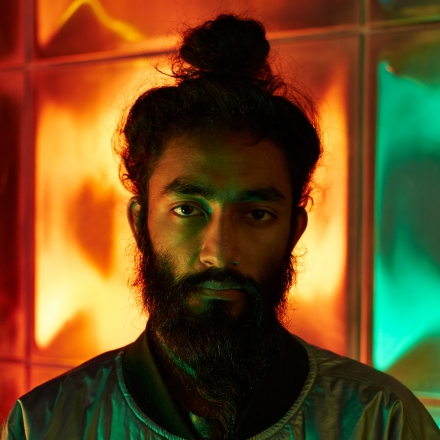
'Sacred pain' or 'mortification of the flesh' is the idea that self-harm might propegate achievement of the spirit, an exploration of which is the concept of London-based producer My Panda Shall Fly's new 6-song EP Higher. My Panda's Suren Seneviratne says that he first encountered an act of 'sacred pain' as a 9-year old in Sri Lanka. Whatever scene of spiritually fulfilling masochism Seneviratne witnessed, it left an impression that still manages to shape his music some 18 years later. Tthe idea that an act of self-harm might itself do psychological harm to a third party is a fundamental part of the distress that Higher concerns itself with. Even more fundamental, however, is the notion that some obscure religious dilemma should reveal so much about our own proclivities for spiritually pointed self-mutilation.
Seneviratne says that after starting work on the 6-song EP, he realized that the tracks "subtly paralleled the diversity of discomfort which individuals put themselves through in the name of religion." Indeed, many of the token sounds of Higher seem to mimic the various documented acts of physical damage that we associate with world religions. The percussive dashes of "haus / transferring sorrow" remind me, for example, of the kinds of self flagellations we associate with medieval Christians (though admittedly, my only exposure to this has been through Monty Python).
These subtle mimicries, however, are not at the heart of Higher's sonic achievement; instead it is the emotional urgency with which these tracks make themselves available to us.
Surely someone like me, the product of an incredibly secular upbringing with almost embarrassingly little by way of religious education, should encounter the concept of sacred pain with a sympathetic hiss and a renewed appreciation for British electronica. Why is it that these songs feel so psychologically near, and how is it that they seem to run so close to the cuff of my daily life? Why do the discomforts expressed on Higher resonate so exceptionally well amongst the architectures of my own life? For most, the idea of sacred pain might seem alien: the cruel totem of some ancient doctrine. For others, it will seem disciplined, enlightened, and something towards which we can look, but in our own lives, so saturated by modern diversions, will never truly understand.
But if you think for a second about the discomforts you put yourself through on a daily basis, in fruitless pursuit (or worship) of adding some semblance of balance and order to your life, the immediacy of sacred pain starts to make itself apparent. When I hear a song like "crac", for example, I can feel myself slipping back into the monotony of my former life as a corporate drone. The track's pounding, cyclical ambivalence makes me think of the two years I spent pushing my way into an overcrowded subway car every morning, staring at a computer all day, cramming myself back onto the subway in the evening, eating, sleeping, repeating. "groupp mind", on the other hand, reminds me of the nauseating slickness and ambient disorder of city life. A dull, distempered existence that includes the occasional oasis: an overchlorinated public swimming pool or a bar with rooftop access. Are these the things that we've ground our souls into the asphalt for? Maybe. Without trying to sound contrived, it might be said that big cities can become a kind of religion to the people who live in them. Higher feels to me as much like an act of self-mutilation in the name of the temple that is London as it does a casual exploration of a worldwide religious phenomenon.
Higher is beautifully reactionary, both in its dogma and its composition. The EP takes in various themes of post-dub and electronic music and strips them of the identities they've been forced into over the past few years. Rollicking trap beats that would usually signal the moment to start moving with s much urgency as you can muster play out as visceral tokens of slow motion psychic despair, signifying something like the discomfiture we put ourselves through with an overindulgance of media ("identification"). And nozzled, retrograde synth sounds don't express a goofy interest in the past the way they would on, say, a Mount Kimbie album. Instead, they seem more apt for interpretation as expressions of misgivings about the recalcitrant social structures to which we shape ourselves ("ark (spirit servant)").
It is likely that I have not interpreted Higher as representative of the types of discomfort and pain Seneviratne himself associates with the EP. And it should be said that Higher does deal with very delicate, literal themes in a very significant and specific way. But I think my misreading actually speaks volumes of Higher's strength as a set of electronic compositions. I do not know anything about sacred pain from a religious perspective, but the idea of hurting yourself - perhaps even damaging yourself irrepparably - for the sake of some existential fulfilment is nowhere near as alien a concept to my life, or to secular life in general, as I wish it were. The confusion, pity, and ultimately - most importantly - empathy I feel when I listen to Higher is enough to send the message that this kind of pain is everyone's pain, whether we know it yet or not.
Higher is out this week on Sonic Router.