


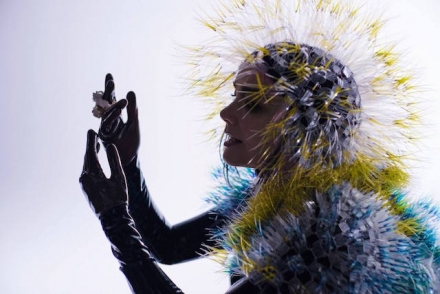
Review: Björk “Vulnicura”
23 Feb 2015 — Andrew Darley
Every Björk album release feels like a standstill moment in music history. Her records are made with emotional brevity and shaped by restless exploration. Electronic producer, Arca, mentioned in an interview in 2014 that Björk had completed a new body of work which he helped co-produce. The trickle of information came as a surprise, yet the bigger jolt was that no one expected it to be released as early as January – not even the artist herself. Quickly after the official announcement of Vulnicura’s release in March, it was leaked online in grainy quality. Taking the issue into her own hands, Björk put the album in its entireity on iTunes to be heard as she had intended.
In her recent Pitchfork interview about the record, she disclosed the dissolving of her marriage as its inspiration, as well as how it relates to its ambitious predecessor, Biophilia. She considers the multimedia album about the connection between music, nature and technology as her way of attempting to accomplish everything (which comprised an album, musical app, documentary, scientific instruments and a school for children). She likened the project’s completion to the closing scene in Mary Poppins; once relationships are finally resolved, the nanny must leave the house she has cared for.
The glaring transition between Biophilia and Vulnicura is that she locates herself once again at the centre of her music. Like many of Björk’s records, Vulnicura fuzes words to form a clue of its content: the vulnerability of heartbreak and its cure. The album is a stark and intuitive chronological documentation of her relationship’s disintegration. Its songs put words on the intangible abyss heartbreak plunges us into. Co-produced with Arca and additional production on two songs by The Haxan Cloak, it encompasses the touchstones of Björk’s music and positions them in a new light. "Stonemilker" begins the story with impassioned string arrangements and the artist’s babbles of disorientation, while "Lionsong" ruminates on the torturous doubts of whether two people can withstand together.
Writing in an admittedly direct way, she makes no attempt to dress up her pain. Its lyrics unfold the lucid moments of clarity amidst the depression, anxieties, loss and frustrations of love. "History Of Touches" stutters in a penetrating electronic arrangement as she laments the last night in bed with her partner (“Every single fuck we had together is in a wondrous time lapse”). The ten-minute "Black Lake" gazes into the void after life is turned upside-down. It fades in and out of focus with mournful strings and propulsive beats as she agonizingly questions “Did I love you too much?”. No matter how bleak, the heart of Vulnicura echoes in an awareness that its creator’s only way of coping with such intense and crippling emotions is through music. The music she has written here embodies the psychological and physical toll of despair – portraying the darkest streams of human thought.
The essence of the record is the distressing journey of finding solace in solitude after a life-defining relationship. On the menacing "Family" she rhetorically asks for space to lament the death of her family. Its pain is palpable in which she sings, “How will I sing our way out of this?”, without response. She offers a deep insight into her own desolation through which it offers a hand to others in suffering. She closes the record with "Quicksand" – a song that profoundly accepts “When I’m broken I am whole and when I’m whole, I’m broken”. Björk does not end Vulnicura with a happy ending, nor does she attempt to lend any resolutions of loss. Instead she casts a light on its potential cure, as its title implies, which is the understanding that we remain to exist no matter what excruciating or terrifying circumstances we find ourselves in. Her personal account of grief is cast in universal language, which is often difficult yet rewarding if one is willing to sit with the pain she sings of. As Björk’s 20th anniversary retrospective launches in New York’s Museum of Modern Art this year, she has synchronized it with one of her most vital, deeply felt records of her career. Vulnicura is the sound of the horrors and healing of the human heart.
Vulnicura is out now.