


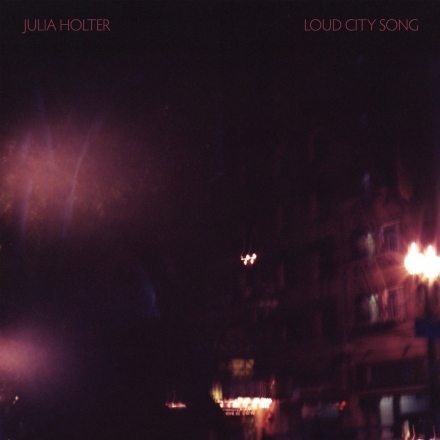
Review: Julia Holter “Loud City Song”
16 Aug 2013 — Henry Schiller
There is music that demands a certain grandeur of location. Yes, mp3 players give us the ability to listen to music anywhere in the world, but when I listen to an album like Julia Holter’s Loud City Song, I really wish I could hear it emanating naturally from the stonework of an ancient temple as I explore the ruins. This is not to say that Loud City Song wouldn’t sound excellent through iPod earbuds, on a car stereo system, or even laptop speakers (not recommended in any case), but it’s an album of such width and contemplative mass that it almost demands a more majestic - and impossible - stage of execution. To listen to it with headphones at a computer terminal could make you anxious, to take it for a walk down the street might make you break out into a brisk jog before you fall to the floor sobbing. Loud City Song is a subtle departure from the bedroom orchestrations of Ekstasis and the caustic experimentation of Tragedy, and it represents Holter’s most reliably pop-fixated and, conversely, her most aurally challenging work to date.
Loud City Song is dense, but Holter’s decision to graduate from solo bedroom recordings to the use of a backing band is actually displayed not by crowded orchestration but by the album’s silences and spaces. The exploratory urgency of a song like “He’s Running Through My Eyes” – a soft medieval ballad – comes mostly from the emptiness that overwhelms the sparse instrumentals and Holter’s voice. Loud City Song is an album that makes you as aware of its absences as you are of its explosively choreographed melodic acrobatics.
Holter has always been something of a maximalist with regard to tone, and the kingdom of melody heralded by Loud City Song represents a confluence of influences and recognizable genre totems. An example of what I mean: after listening to Loud City Song a few times I was actually watching an episode of The X-Files and noticed that the background music sounded almost exactly like a particular chord change in “He’s Running Through My Eyes” down to the tone of the synthesizer. Everything from overwrought TV compositions to minimal electronica is implicated in Loud City Song. Everything subject to rejuvenation.
There are some distinctly new age influences on Loud City Song, starting with the almost unaccompanied vocal intro to “World.” Holter’s proclivity for subtitling grand art rock structures with jazz instrumentation and lounge tones – especially when it comes to the album’s upright bass parts – is reminiscent of Talk Talk’s Spirit of Eden LP. “In the Green Wild” is as much late Arto Lindsay as it is early Kate Bush, containing strange hints of each’s Invoke and Never For Ever albums respectively. The latter seems to be, if not a direct influence of Holter, a startlingly apt comparison point, especially on Loud City Song’s proclivity towards creating tonal swells out of the dialogue between deliberately separated instruments.
Holter has transformed herself vocally from a bedroom singer into a powerful invocator. Even her most carefully pedestrian lyrics sound like they’re being read from a spellbook. There is a haughtiness - even an aristocratic tendency - to Holter’s compositions. Steeped as her music is not in parochial folk tunes but in elegant composition, she stands distinct from other artists who also tend towards painting musical landscapes out of pop and baroque elements, like Joanna Newsom or Bill Callahan. There is no Shenandoah here, no rafting trips down the Potomac river; only images of classical mythology and Bald Mountain loom over the doomed metropolis that Holter and co. are architect to.
Yes, Loud City Song does give us glimpses of the city; “This Is A True Heart,” which pits smarmy jazz against digital horror, makes you feel like you’re walking down the Venice Beach boardwalk at night only to have Rowling’s Forbidden Forest explode from the boardwalk and swallow you and your Walkman up. “Maxim’s 1” shares lyrics as well as a general structure with “Maxim’s 2” which unfolds as something like a more mechanical and striking version of the former. If “Maxim’s 1” is a congress of druids in a beautiful forest then “Maxim’s 2” is its corollary inner-city block party. Loud City Song earns its title not through being particularly appropriate for city listening (I’ve made it clear, I think, that this album deserves the benefit of a majestic natural theater) but through being – at times – startlingly evocative of big city ambience.
Closing track “City Appearing” gives a directness and modern pop sharpness to the kind of roving spiritual elegy that Pink Floyd explored on songs like “Echoes.” The song follows an orchestral ramp up from contained dreamy jazz to something fiercely unhinged. Loud City Song is the kind of album that puts you in a position to assume that “Horns Surrounding Me” refers to the horns of an animal or of an old wizard and not those of brass. Lost City Song is the space age as described by Pliny the Elder, it’s an episode of Star Trek written by Geoffry Chaucer; it is the distant future of chamber music’s past. Loud City Song is a medieval jazz album.