


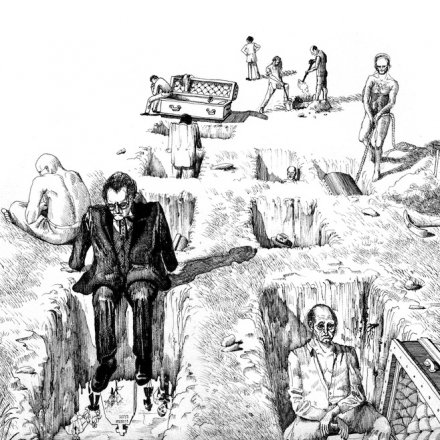
Review: Laurel Halo “Chance of Rain”
28 Oct 2013 — Evelyn Malinowski
Chance of Rain, out today on Hyperdub, wreaks of a place called Cafe Minimal Techno. Given the fact that Laurel Halo composed the album during an extended stay in Berlin, perhaps a rainy one, such aroma can be sniffed out through the music quite easily. Apart from this rather imaginative, cross-sensual take, the atmospheres brewed by Basic Channel, Deepchord, and even a particular song by Moonface are vaguely in the air of this excellent album.
Like a lot of Halo's works, there's something familiar about her sound, and certainly not in the way that it's recycled or archetypal: it just makes sense. It fits, generally. Experiencing laconic and concurrent music through an instrumental techno album suits general existence even better, not altogether unlike Adorno's “academic listening,” or the half-taboo purpose of Muzak. The untrustworthy genre functions for the purpose of rewriting known songs into calmer, more utilitarian versions. Rather than rewriting familiar song, Chance of Rain revises facsimiles of places or intersections we've been through before. There's a theme traceable throughout the album apart from the cafe techno idea: the work expounds different timbres and already esoteric foundations, like ones as difficult to find as things left in places we are no longer located in. In other words, Chance augments dimensionally and sometimes temporally withheld corners and angles; the subtleties of fleeting atmospheres.
Bending temporality and enhancing familiarity might remind us of Donnie Darko and his manipulation of dimensions. Moveover, Chance's numerous indistinct samples in refined rhythms in a way cite the enhance photo scene in Blade Runner, when Deckard uses the Esper apparatus to manipulate the dimensions and reflections of surfaces in the photograph found in Leo's hotel room. There's always a chance of rain in Blade Runner's Los Angeles. That said, “Melt,” the fifth track on Chance, contains an amount of Vangelis-got-the-blues, while the following track “Still/Dromos” offers a direct melodic reference to parts of the Blade Runner score.
Leaving Blade Runner and Donnie Darko aside, Halo's entire album might be an enhancement and magnification of overlooked corners in fast-moving “Head” from her 2011 release Hour Logic, a dynamic track that emulates train travel - and, perhaps, time travel in parallel accordance to the way H.G. Well's The Time Machine reads - when objects approach and rush by while a hum remains more central and consistent. Such an analogy is firmly reinforced by the train whistle in the middle of the track which occludes the entire soundscape for a moment. “Serendip” on Chance drags but progresses while a deep, bassy whistle shredding around in the background of the song reminds us of “Head” and its blaring train. But the new track's dimensional dissection holds the horn in order to look around only within that angle before engaging the bassy acid which provides a warm center of the song, thereby differing from “Head.”
“Oneiroi” little by little unfolds rapid and subconscious samples, like ones tucked away in weird and unsuspicious corners. While it's difficult to describe, the track's signature sound is a metallic siren, the sound of ancient dictating rings or coins creating wind. A similar sound and effect can be found in Pole Foler's “Enter the Rhythm,” of all songs. “Oneiroi” starts strong and snaps us into a mostly concealed and dimensionally interrupted place for examination which sustains for the duration of the album.
With “Chance of Rain,” Halo seems to be primarily hinting at progressive house; But, with the distance-providing distortion over the piano loop, the track remains safely minimal and deliberately never makes it to a place of relief, although remaining minimal is quite alleviating. It's like being in the doorway at the top of the stairs in Berghain, where you can hear Panorama Bar colliding and even synchronizing with the main floor: that's the title track's corner conversion. The progressive house is mostly hinted at by the melody that comes in closer at the beginning of the song then distances itself again, followed by strobing and ticking percussion. The latter battles over the wavering former, and acts as a more significant element to the song, interrupting an aural escapade toward a climax, or at least secure grounds on which progressive house can stand. Then, towards the middle of the song, we are taken out of the haze. The drums and distortion quit momentarily to reveal that the loop is rather sober and simple. Still, the fog never lifts, really.
Indeed, there are several ultra-fine details in most corners of each track which compliment and establish our curiosity as to whether Halo's voice and melodic capacity will soon overtake the track. This never occurs, apart from the voiceless, rainy-night jazz last track, “-Out.” Chance seems to display minimized use of language in order to capitalize on no language – no lyrics – which maybe stems from being in a city full of a foreign language (in Halo's case, Berlin). We then find other ways to communicate and relate to our surroundings. It's an excellent situation for the adult imagination.
In the end, all of these analogies created in order to praise this exciting, late autumnal release come together quite nicely: rainy, foreign, sci-fi city and its musky and gray cafes; Blade Runner and Donnie Darko; dimensional magnification; Halloween. Costume wearing is in a way an exploration or enhancement of a covert angle of our interests or personal histories. Clearly, this is a strong addition to Halo's relevant discography and yet another timely release.
Chance of Rain is available on Hyperdub.