


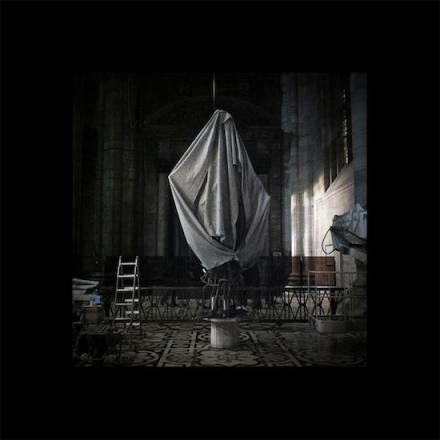
Review: Tim Hecker “Virgins”
14 Oct 2013 — Henry Schiller
In a 2006 interview with Pitchfork Media, Canadian electronic artist Tim Hecker mentioned - rather offhandedly - that he was pursuing a doctorate degree. Since that was seven years ago, one could safely assume that Hecker has obtained his PhD, and is now some sort of academic. He probably has a very busy schedule, and as such he has the perfect excuse to be a little lazy / let himself get sloppy / take all the easy ways out when it comes to making music. I can make this assumption becaise I’m currently in the first semester of a liberal arts masters (see: not particularly time-consuming) and I can barely get my posts in on time.
But Tim Hecker makes no excuses for himself: his latest album, Virgins, sounds like the product of 27 hour workdays, a forced emotional solipsism, and what could only be described as an atomic devotion to soundcraft. This is not a hobby or a part-time job; it’s a calling. Virgins explodes with the lushness of sunlight dripping in molten fistfulls down the walls of a presbyterian church; recedes with such ephemeral swiftness that you are left clawing after it for fear of being left alone in the dent its just carved.
“Virginal I” is inseparable from opener “Prism” and each give their own account of the madness you are about to be engulfed by. “Prism” is a geometric shock to the system; a series of gargantuan blasts which excuse themselves into peripheral tumult. “Prism” moves seamlessly (a feature persistent throughout Virgins) into “Virginal I”, whose cyclical bell sequences exhibit just as tremendous a display of compositional oomph as its predecessor's assault.
But where “Prism” anticipates Virgins’ keenness for sonic necromancy, “Virginal I” exemplifies the album’s emotional intimacy. The densest tracks on Virgins are the tormented “Live Room” and closing track “Stab Variation”, but Hecker has the constructive intelligence to know that powerhouses like these wouldn’t work half as good without counterpoints like the soothing “Amps, Drugs, Harmonium” or the off-puttingly distant “Incense at Abu Ghraib”. On Virgins, the smallest songs give something for the biggest ones to be bigger than, and these in turn add a haunted legitimacy to the album’s less aurally occupied moments.
In the same Pitchfork interview that I linked to earlier, Hecker mentioned an affinity for the works of Henry Miller. This is not surprising, given his predilection for albums that act more as a singular, insistent, pulsating whole than chaptered, rigorously structured affairs. Virgins is an album built in and for an age of some digital continuity between body and mind; it pulls you into its world but it negotiates its meaning with you on your terms, too. I normally wouldn’t recommend an album of such sheer density be rummaged through with anything other than explicit devotion, but for Virgins I’ll make an exception: listen to it wherever you can, as soon as you can.
Virgins is out now on Kranky.