
Label Profile: Orchid Tapes

11 Nov 2013 — Andi Wilson

It's challenging to portray the emotions obtained from watching something you really love and believe in grow tremendously, like a flower. Or rather, an orchid. In an environment such as Brooklyn, the aspect of community can be one of the most difficult things to achieve. With the continuance of bustling, competition, among other strivings in this enormous city; the most imtinate and gratifying moments have been spent knowing we have community and each other in the music scene. Being said, there are aspirant people here that are achieving and sharing intermutual relationships digitally and virtually in an extroardinary way. In this case, a label few and far between. Today we share the thoughts, devotions, and a very personal interview from Warren Hildebrand, founder of Orchid Tapes.

AW: When and where did the idea of Orchid Tapes first begin and how did it evolve into becoming an actual label?

WB: Orchid Tapes was first conceptualized in late 2009 right after I moved out for the first time and into a small apartment in downtown Toronto, I had already released a few tapes as Foxes in Fiction while living at my Mom’s house in the suburbs but I hadn’t put them out under any kind of name or anything. In February 2010 I released Swung from The Branches and it was kind of the official kick-off for Orchid Tapes existing. For the first few chapters of it’s life it really felt more like a pet project than an actual legitimate label, it took bringing Brian Vu onboard with the label and getting to know some really talented musician friends to really bring it into it’s current incarnation.

From top left to right: Foxes in Fiction, R.L. Kelly, and Happy Trendy performing at the first Orchid Tapes showcase. May 18th 2013 @ Living Bread in Brooklyn. Photo set by Daniel Dorsa.
Read more →

AW: What was the initial response like for Swung From the Branches being OT’s first release in 2010?

How has OT changed in growth since the first few releases?

WB: The initial response to that album was really swift and weird and unexpected. It’s a really long and convoluted story, but a few days after I posted the record for free on my old Blogspot a completely renamed and retitled version ended up going viral on 4chan and there were a bunch of rumours circulating that it was secret side project of Bradford Cox or something stupid. Some blogs ended up picking up the story in an attempt to figure out who was behind the album, and I did my best to try and clear everything up. Thankfully it didn’t become too much of a viral wildfire before I intervened and everyone who heard it was able to put the proper name to the project. I think all-in-all it was more of blessing in disguise because that weird wave of awareness around that album is definitely one of the big things that caused people to hear that album. Just a month after it happened Pitchfork ended up posting some of my music, which was really cool and unexpected. The internet is insane.

Orchid Tapes today is almost completely different than when it was when I first started it. In the beginning I didn’t really know too many musicians who had much interest in releasing things on a brand new label (this was right after Arcade Sound Ltd. had been revealed to be a scam label so there was an understandable amount of apprehension hanging around a lot of people that I associated with). Also, a lot of the early releases I did were really amazing, but I don’t think there was much of the sense of cohesion or togetherness that defines the label these days. I would basically just say ‘yes’ to anyone who asked to do a release, and got turned down by 95% of the people I would ask to put out a tape.

Even just in terms of resources, there’s a lot more available to now; for the first 20 releases I would dub every single cassette tape on my stereo tape deck, which would literally take days and days to finish. It wasn’t until last fall that I got a proper cassette duplicator. Also, since moving to New York it’s become a lot easier to get things like blank tapes, j-cards and other goodies that we use to put our packages together. And there’s two of us now, which is great!

From left to right: Coma Cinema and Alex G performing at the first Orchid Tapes showcase. May 18th 2013 @ Living Bread in Brooklyn.

AW: What have been some of your biggest accomplishments/struggles with OT?

What kind of advice would you recommend to anyone wanting to start their own DIY label?

WB: For me, the biggest accomplishments have been the three showcases that we’ve done this year. Not only were they fun in every way, but they represented a culmination of everything positive that’s happened for Orchid Tapes, my music and the music made by all the people I’ve become so close with in the past three and a half years. It’s one thing to have a cool project like this that’s based largely on the internet, but to have a group of bands / musicians come together for one show AND have people actually come out to listen is a really amazing and indescribable thing. Definitely some top 10 life moments in there. To someone thinking of starting their own DIY, I would recommend to just start small and be very ambitious and dedicated with it. It can seem sort of daunting at first but the more love you put into it the more you’ll get out of it.

AW: How have you found most of the artists you release on OT? Internet relationships, shows, through friends?

WB: Most of the releases we’ve done have been the product of internet relationships. Thankfully we’ve all met and hung out in real life a bunch of times now but I had become internet friends with people like Mat (Elvis Depressedly / Coma Cinema), Rachel (RL Kelly) and Dylan (HAPPY TRENDY) long before we ever made any plans for them to release music on Orchid Tapes, but that’s been a really nice thing, and it’s made doing releases a lot more fun and easy going since everything’s discussed and arranged just as a friends. I also met Tom of Home Alone after he started dating my best friend Amanda, and I met Dan of Four Visions, who we’re working on a release for right now, at a show we both played in Brooklyn.

AW: Having seen two out of the three OT showcases, it has been so impressive to witness how cohesive and moving they have been, especially to the community here in Brooklyn. Were the showcases relatively easy to organize?

WB: Aw thanks! Honestly, we had no idea how the first one was going to turn out and it was a total shock to see that many people show up and have there be such feeling of positivity. It’s all really thanks to all the bands and musicians who travelled from so far away to come and play, and to the fans who travelled just as equal amounts of distances to come and see us do our thing. There was a lot of organization that went into planning each one, but it definitely wasn’t as much as I thought it would be; we’ve been really lucky with the spaces and organizers that we’ve worked with who’ve helped to make everything a lot easier for us.

From top left to right: Julia Brown, Four Visions + Warren, and Home Alone performing at the third Orchid Tapes showcase during CMJ. October 19th, 2013.


AW: Ricky Eat Acid’s ‘Three Love Songs’ will be OT’s first vinyl release. Do you think there will be more vinyl releases in the future?

WB: Definitely, this is something that we’ve wanted to branch off into for a long time, and I think this is the perfect record for us to start off on a new format with. It’s honestly such an incredible album and we’re so excited to be involved in releasing it. We’re still in the planning stages with everything, but there’s gonna be a lot of neat extras and pretty things included with the physical release. Stay tuned.

You can visit Orchid Tapes' website and bandcamp for details and news on upcoming releases and events. 


Interview/Video Premiere: Easter

05 Nov 2013 — Lukas Dubro

Stine Omar doesn't know what prompted her to speak to Max Boss that one afternoon in Berlin. Did god show his face here? Or did she just follow a whim? One thing is for certain: On that day, two people came together who definitely belong together. A friendship began, that soon led to making art. Stine and Max recorded videos of themselves and started a musical project which they first called Euroshit and later on became Easter.

The music of Easter is hard to locate, it is a mix of various styles, times and genres. Because of this, the music was given the obscurest of labels, such as post human or post gender. We met with Max and Stine on a sunny afternoon in the backyard of the famous champagne bar Smaragd in Wedding. They had spent the whole day at the lake and didn't wear underwear. Stine had a slight sunstroke. After a chat about Tropical Island, their band and food, they gave us a banana.

Read the interview with the duo after the break. It first appeared in German in Cartouche #4. Go here to find out where to purchase a copy of the magazine.

Aside from the interview, we're happy to premiere the new video for Easter's wistful and most excellent song "Sky". Check it out below.

(Photo by Tonje Thilesen)

Read more →

It's always a kind of trip to go to Wedding. Do you like it here?

Stine: We love Wedding! I've been living here for two years with my friends Franz Augustin and Osman Eriksson.

Max: I moved to Wedding last year, felt home very soon! Still, I wanna try to convince Stine and my brother to move to LA.

Stine: Taco stands everywhere, I heard.

You like tacos?

Stine: Yes.

Max: Makes you happy.

Stine: It does make me happy! Beans! We have a song coming up about tacos! TV TRAY TACO NITE.

Talking about your band Easter: A lot of your songs are accompanied by a video. Could you explain why?

Stine: It's fun to make music videos. And super easy too. Ideally we would want every song to have a music video. Just to have it on Youtube with some eye candy.

Max: The plan was to make an album and to make a video for each song. We prefer to post a Youtube link over Soundcloud, it's more interesting and popular at the same time. 

The video for "The Heat" plays at Tropical Island. What is your impression of this utopian waterpark?

Stine: It was sick. Everything was grey. We arrived there in the afternoon and stayed until 3 in the morning. We walked around in this huge thing until there was almost no more other people – only these super scared flamingos. One day we will free them. We also sat down at this perfectly prepared table that people left who had to catch the last bus to civilization. It was filled with tapas.

Max: But overall it wasn't as bizarre as I had expected. I thought they're close to bankruptcy and it's this ghostly place, but it was actually quite crowded during daytime. You often see people walking in the back in our video. I had intended that there would be no one in the back. I also thought they have a more real beach, but it was just some sand at the edge of the pool. Not beachy. The initial image I had for the video was that we would stand navel deep in the water close to the beach. But it wasn't possible.

Why did you want to do the video there?

Max: Outside was the darkest Berlin winter. We wanted heat. It's like 32°C. We also wanted to go because everybody knew about it but nobody had actually been there.

Stine: We only realized afterwards how much it fits the song. Because it was written in Lanzarote last year where i was studying satanism at a beach surrounded by fat sunburned pensioners.

Would you ever go there again?

Stine: I'd rather go to Plötzensee.

Max: They have amazing slides but I don't get why the white trash goes there. It's so much more expensive then to actually fly to the south.

Seeing all these videos and listening to your songs, it seems like you are very determined about your style. How difficult is it to develop your own artistic language?

Stine: I don't know anything about style. It's just the meeting of the two of us. It's just what's going on in the making.

Max: If there is a process, it is very much visible. Because we put out everything  we do. There is no unreleased demos or stuff. It's funny when people see things in your work that you haven't intended. All this artificiality and coldness in our visuals. And then you look at the Facebook cover photo and you kind of understand what they mean.

How do you see your music? Do you have any intentions?

Stine: Maybe to put this image of a perfectly shaped horse ass into people's head. But besides that I just do it because it's more fun than anything else. And that I want to be with Max all the time anyway. Very much what we do is about reaching more fun.

Max: Yes. MORE FUN. In capital letters.

Stine: And exclamation mark.

Max: In a way this is a precondition for me to contribute or to collaborate with someone, to not have really an intention. To let go of what you would do just by yourself. To trust in the qualities of another person. That's the reason why you wanna work with someone. Because you believe what the other person does is good and will bring something new. And you just let go. This is what a collaboration is about.

How do you write songs?

Max: The base is always Stine's lyrics. There could never be an Easter song without them being there first.

Stine: I write poems. And Max interacts to them in Ableton.

Do you have any influences?

Stine: It's hard to say where it comes from, but it's much about food I think. At least that's my favourite interest.

So food is important?

Stine: Yeah, food. And love and hate and horses.

Is food what Alien Babies is about?

Stine: It's about texture. Texture of weird stuff some people call food.

Do you like cooking?

Stine: Yes.

And eating?

Stine: Yes.

What is your favourite meal? Pasta?

Stine: I hate pasta.

Max: Pasta makes you depressed.

Stine: Pasta makes you sad. I am not allergic, but it's very bad for creative purposes to eat too much pasta. This is probably a huge contemporary problem, because a lot of people eat a lot of pasta, because it's cheap and easy. Sad, sad pasta.

Is there food that makes you happy besides tacos?

Stine: Bananas. Today we only ate bananas at the beach. Yesterday we made ice cream of bananas. We just mashed them and put them in the freezer. Happy days.

Do you eat something specific before you write poems?

Stine: Drugs! potatoes! Do you want Swedish tobacco by the way?

No, thanks.

Stine: But you know it, right? It's a big contributor to happiness and concentration and therefore creativity. I love Snus.

Do you like going to restaurants in general? Do you dine a lot in restaurants?

Stine: Maybe not enough. That's what's great about touring, that you have to eat out. It's of course super nice to be taken to restaurants in new cities. When we were in Den Haag, we had Surinamese for the first time and it was so good. This huge pancake with tofu, potatoes, tempeh, beans and everything that is yellow and good on one pancake. Berlin needs Surinamese, I don't know of anything like that here.

Maybe your love for food is what makes your music so special. How do you like the labels given to you? Like post human?

Stine: That is also very entertaining about making music. That people are so into labeling it. At first I was letting myself be annoyed by it. But now I just think that it is funny, that they throw a new genre on you every week. We don't need to label ourselves, we have the people do that for us.

What are the plans for your band?

Stine: We wanna get big in Japan. At least for going there.

Max: For the candy.

So you like Japanese candy too?

Max: Yes. When we went to Paris the promoter gave us a Japanese candy called Octopus Poop. It has a lot of chemical reactions going on. You need a YouTube tutorial to know how to prepare it. It sure has a crisp taste. I tried to find it in Berlin. It seems to be impossible.

Stine: If anybody knows where we could get it here, they should definitely call us.

You seem to like food a lot!

Stine: The art has always been parallel to the food. Cannot do without.
Interview: CFCF on “Outside”

15 Oct 2013 — Evelyn Malinowski

Mike Silver, aka CFCF, has earned a reputation for creating soothing, nearly too soothing, synthscapes. His first release, Continent, along with his well-played remixes of Health's "Triceratops" and "Before Tigers" have placed his openly new age style into familiarity. Earlier this year, Silver released an EP entitled Music for Objects, which characterizes our interpretive relationships with certain materials and househeld objects. The piano-centric work parallels those lovely mornings were the sun finds its way into the house, and shimmers in a glass of water left on the counter.

Outside, due October 21 on Dummy Records and Paper Bag Records, is a new work which conceptually and structurally evokes separation, distance, and being on or going through the borderlands. As aimlessness is something that all of us have experienced when traveling, even if we know where we're headed, it is interesting, even useful to contemplate those memories of weary, anticipatory transit through Outside. That sense of exhaustion, yearning, and even gazing out of the window are delicately sewn throughout the album.

The new album likewise will make you want to put on Roxy Music's Avalon or Kate Bush's The Sensual World, maybe a David Sylvian record, as you fetch a wool blanket and curl up to do whimsical some reading on an autumn evening.

Silver and I recently discussed the themes of distance as well as seasonally appropriate music. We also touched on geographical features of northeastern North America, new age, OPN's new album, and rivaling cities.

Read more →

Well, first of all, I'd like to say congrats on the album. It's really nice, and I find it very appropriate for this time of year.

Thank you very much! I was definitely hoping it would pair well with the season.

It for sure does. I remarked last year in a letter to a friend that it amuses me how every fall, the perfect album or few albums hit right as autumn nostalgia kicks in. Outside is definitely one of those for me right now. On that note, I read in the promo summary that the emotion of being in transit and in between is captured in the album. Do you care to elucidate on this? Where were you traveling to/from, and was the reason for traveling significant in the creation of the album?

Basically it was a lot of traveling back and forth from Toronto and Montreal, and Montreal and New York. Trains and buses, usually leaving early in the morning, sometimes at night. The reasons for travel didn't really play into the album -- it was really journey itself, and getting kind of lost in transit, watching the landscape go by and being immersed in those surroundings -- kind of as a fantasy in contrast to the boredom and restlessness of being on those long journeys.

One can definitely perceive of early morning colors and mist, and of days that never really light up. Perhaps that's a part of being lost in transit? We lose our grasp of time and feel somewhat dim.

Yeah. There's a kind of half-there mental state. So a lot of the time I prefer to just stare out the window and allow my mind to wander instead of like, watching a movie on my laptop or whatever.

Right, and let the day pass. So daydreaming out of train or bus windows, and watching the landscape, perhaps in the company of some instrumental albums, or Bonnie Prince Billy, is definitely a dreamy way of coping with idle time. You're a sort of unabashed lover of new age and muzak-y dreamscapes, right?

Haha yes. Actually right now I am listening to this two-disc compilation that just came out of Private Issue new age called I Am the Center, really great stuff. 

Oh man. I have been in search of some new, new age. I'll check it out.

Yeah it's great!

Although it's a big and banal question, are you in touch with what draws you into new age dreamscapes musically?

Heh, yeah I don't know what it is exactly that draws me to it. There is a kind of naivete and separation from pop expectations, by which I mean expectations of personality, provocation, engagement with pop culture. It's music that usually has very clear and pure intentions, which is to evoke.

But with distance and separation, to look at things through a glass window, or from the borders?

Well I think the music is really about intimately exploring sounds, without detachment or irony. But yeah in relation to the album, that was the thing that I think made it an interesting concept as it started to become clear to me… that separation from nature, rather than being immersed in nature which is what a lot of new age music is kind of evoking. So being on this bus or train that just completely sucks, and then just out of arms reach, this natural splendor.

That's quite a beautiful yet tragic circumstance... Isn't the region around Montreal/New York/Toronto quite green and forested? Maybe hilly?

The route from Montreal to New York is definitely hilly and forested. It's the Adirondacks, which is just one of most beautiful forested areas in the USA. That would be the bus route. The train is more standard but you get to see a lot of that in the distance. And the train to Toronto passes Lake Ontario for a while, so you have this gorgeous view of the water on the horizon, and then for a while it's a lot of these rural areas with kind of dilapidated houses and stuff, still quite beautiful.

I'm going to Toronto next week to check out a school there. Never been - really looking forward. I've heard a lot about its uniquely compelling atmosphere.

Haha I'm personally so-so on the city – I think like a lot of native Montrealers there is just something off about it for me. but I always have fun when I'm there, my sister lives there.

We do tend to choose our cities... Seeing that separation is a conceptual theme of the album, would you reckon that, structurally, the spacious, echoey, even tribal drums represent this sensation? Or do the melodic sequences, especially in the first three songs, with their lamenting, solemn anticipation (I would say), better reinforce distance and removal? That's sort of a weird question.

Haha. I really can't say which sounds would correspond to which emotions -- I choose the sounds because they do for me evoke elements of a nature which are both frightening and attractive -- and it's kind of trying to build a world that only really exists in this music. So for me choosing these sounds is a more intuitive thing, I never really intellectualize the choices. After the fact it might be interesting to try to make those connections though… but I don't think I'm the person to do it.

Are you the singer?

Yes.

Also on the Bonnie Prince Billy cover? 

Yes. There are backing vocals by Stefanie Franciotti of SLEEP∞OVER. But I am the primary vocalist on all the songs.

I listened to the original, which has the same dissonant vocal harmony, but the cover on the album is completely haunting. Between you and Stefanie, was there any attempt, be it intuitive or deliberate, to take the innocent sounding original and turn it at all darker?

I find the original to be quite dark, but with quiet hopefulness. To me it's like the sound of those dilapidated houses, with debris in the yard and giant puddles of rain with rotted wood in them. I definitely wanted to kind of amplify these things that the song showed me, and make it kind of grandiose, epic.

It definitely comes through. I find that the instrumental melody, or melodic chorus, offers some release after the first two tracks, and parts of the third, build up on feelings of longing. It's a very powerful moment in the album. Track two, "Jump Out Of The Train," is likewise haunting and in a way loose-ended. It reminds me of Oneohtrix Point Never's anthem "Returnal," and has the same lamentation. OPN is another of few openly "new age" or "quasi-new age" musicians out there today who stirs a lot of intellectual interpretation. Do you have any OPN records?

Yes for sure I am a big fan of Daniel's work, he's a great guy as well.

His new album also debuted in time for autumn, but on the earlier side, while CFCF's is deeper in the heart of autumn. Have you heard the new OPN, and do you find it satisfyingly new age?

It might be his most openly new age record yet, but fascinating how he both unironically employs that style while also using its artifice as kind of a comment, there is a lot of humour and total earnestness going on on it which I really love.

Music and humor definitely mix, and there is quite a bit of it in OPN for sure. The combination gives a song a type of soothing and very human glaze, I think. Speaking of which, I have one more question: it's sort of nerdy. Do you care to talk a little about the message behind "The Crossing?" I read it as a sweet, caring song about helping oneself or someone else unwind at the end of the day, and to know when to call it quits, saving the rest for the following day.

That's a nice interpretation! The funny thing with lyrics is I'll write them and they have no meaning other than kind of trying to convey imagery that works with the music, but then gradually as the song takes shape and listening to it a lot I start to find out of what it means to me. So with “The Crossing” I kind of see it as this apology and attempt to re-establish devotion after a painful/failed journey. Like returning after casting off responsibilities and admitting that that human connection is something truly valuable and tangible.

Traveling and being physically in motion does automatically make the traveler cast things off, including communication with others. Did you feel that your journeys which inspired this album ever failed? Or were a misfortune in the way that, three hours down the road, you realize you forgot something and suddenly feel unprepared?

Haha I'm sure that kind of thing happened somewhere along the line. I've missed a couple trains as well. Or running to catch a flight… I mean, usually the purpose of the journey, a show, visiting someone or whatever, that's kind of an afterthought as far as its relationship to the album… it was really about just being in that in-between space.

I like that space as well.

Like the autumn, Outside starts strong, dreaming, full of anticipation and special awareness or love of being in that vulnerable, changing state. I recommend that you will love it from the moment it starts.

Outside is out October 21 on Dummy and Paper Bag Records.

Watch: Teen Beams “Round the Cathedral”

04 Sep 2013 — Henry Schiller

Teen Beams is the recording project of Danish musician Niklas Langeland Pedersen, and below is the perhaps unofficial video for his song "Round the Cathedral". Sounding like a Cocteau Twins influenced version of Ducktails, "Round the Cathedral" takes me back to the halcyon days of 2009, when everything sounded like the mid '90s had been run through a flanger. There is a definite Smiths-influence on the guitar work that is audible beneath the effects, as well as on the song's gloomy-but-gorgeous aesthetic.

Do we move too quickly from one indie rock fad to the next? Are we, the music journalism community, crushing out genres before they even have the chance to grow? I'm not sure, but I do worry that people won't give Teen Beams a chance because his sound is a few years out of the mode. But "Round the Cathedral" is a fine piece of psych pop, and worth sullying your reputation as a forward-thinking music snob to get into.


Read more →

Interview: Five Years of Leisure System

16 Aug 2013 — Henning Lahmann

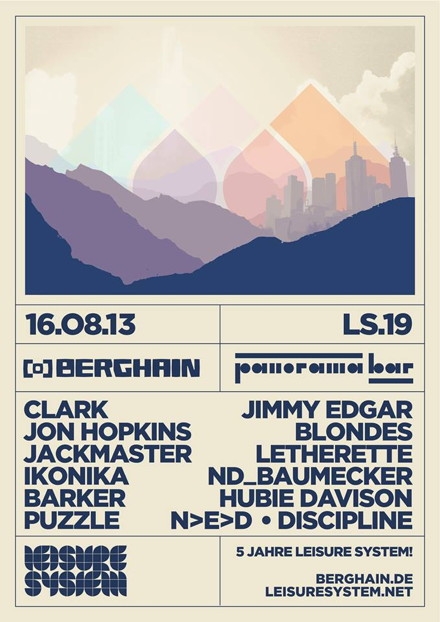
Tonight, beloved Berlin label/collective Leisure System will celebrate its fifth anniversary with the 19th edition of its legendary resident night at Berghain. Looking at the line-up, there's actually not much more we can say: With Jon Hopkins, Clark, and Blondes performing live, and Puzzle, Ikonika, N>E>D vs. Discipline, Barker, Hubie Davison, Jimmy Edgar, Letherette, Jackmaster, and nd_baumecker behind the decks, the word 'killer' will get a whole new meaning this night.

Find out more details about the event over at RA or Facebook.

Yesterday, we had a brief chat with Leisure System member Michail Stangl to talk with him about the label's beginnings and future plans. Read the interview after the break below.

Running Order Berghain

23:59 h - 02:15 h Puzzle

02:15 h - 03:15 h Jon Hopkins  LIVE

03:15 h - 05:00 h Ikonika

05:00 h - 06:00 h Clark  LIVE

06:00 h - End N>E>D vs. Discipline

Running Order Panorama Bar

23:59 h - 01:30 h Barker

01:30 h - 03:30 h Hubie Davison

03:30 h - 04:30 h Blondes  LIVE

04:30 h - 06:30 h Jimmy Edgar

06:30 h - 08:00 h Letherette

08:00 h - 10:00 h Jackmaster

10:00 h - End nd_baumecker

Read more →

What was the original idea behind Leisure System? 

It was actually less an actual idea to launch Leisure System than the right timing. Berlin's electronic music scene had just started to flourish again for the second, third, or probably even fourth time, and there was just more interest for stuff off the beaten track of mainstream underground. 

Some of your own projects – such as Not Equal – are more situated within a darker, more experimental corner of experimental music. How does that fit into the Leisure System collective, and what's the process of agreeing on new signings?

We all here at LS are pretty different characters, but we all share a certain eclecticism when it comes to our tastes, reflecting a very broad range. On one side that's complicated as we always end up being completely carried away in our discussions, but it's also very conducive to our decision making process because we look at and assess things from numerous angles and preferences regarding genre, sound, or drums. However, that has also led to the fact that our previous releases are so diverse, as have been the line-ups at the Leisure System nights. There's simply too much interesting music out there, so we definitely don't want to end up listening to the same sound for 12 hours straight.

What's up next for the label? Is it just my own impression or are you starting to increase the release rate a bit?

The release will be Tim Exile's first EP in four years. He's always been part of our circle of friends and I really admire him as a musician. This year's definite highlight will be Dopplereffekt's Tetrahymena EP which will drop September 30, but there nothing that needs to be said about that one. Those will be followed by EPs by Kommune1, one of the best techno acts if you ask me, hopefully a peep from JETS, and Hubie Davison, who will be having his premiere at Panorama Bar tonight.

What can we expect from Hubie's EP? When is that one due, and what do you find exciting about his music?

I don't want to give away too much by categorising and describing his music, but his EP, which should arrive in late October, will probably the most quiet and densest material we've released yet. I will only say that much about Hubie – it was the first-ever demo in our inbox that we all could agree on immediately: this has to be released by Leisure System!

NFOP Recommends: Urban Mutations w/ Bok Bok at Chesters

07 Aug 2013 — Henning Lahmann

While we would never object to the well-considered and indeed long overdue list of "Five Berlin Club Nights That Have Nothing to do With House or Techno" that Electronic Beats published on Monday, as it more or less exclusively features friends and family of ours, one essential portion of the 'other side' of Berlin club culture however surely was missing: Urban Mutations, a monthly night at Kreuzberg's Paloma conceived by DJ MFK and DJ WEN, which takes a fresh approach to contemporary dance tropes somewhere along the lines of future bass, UK Funky, ghetto house, and juke. In addition to that, the two also have an impeccably tasteful show on Berlin Community Radio.

This Saturday, August 10, Urban Mutations will once again step out of its Paloma familiarity to host a night at Chesters, this time featuring the appearance of Night Slugs mastermind Alex Sushon aka Bok Bok, who will be visually accompanied by Janitor  – check out the event's details on Facebook and RA. Needless to add, this one's highly recommended.

In anticipation of the event, we spoke to Urban Mutations' DJ MFK aka The Hague native Koen Nutters about the project's concept. Read the interview below.


Read more →

When did you start Urban Mutations, and what was the original idea behind it conceptually?

We started DJing together in 2011 at O Tannenbaum and the Times bar in Neukölln. The idea was to play a bunch of UK Bass, Juke, and other current stuff and mix it in with older Chicago-style club music in order to create a more interesting flavour on the dancefloor but still make people dance like hell. Which I think is very much needed in the techno-dominated city of Berlin. Now we are collaborating a lot with the people from Festsaal Kreuzberg which is great because it gives us quite a neutral platform to organize things in. We have our monthly night at Paloma and were doing bigger things, like our DJ Rashad night and the upcoming Bok Bok night, at Festsaal itself which sadly burned down the other week but will continue its activities elsewhere until it's rebuilt.

Urban Mutations is not only about music, but also about the visual experience. What's the approach, and who are the artists that contribute to your nights? Do you find most of them here in Berlin?

The link with the post-internet crowd and visuals just comes from the fact that I know these people very well and like the style very much. Particularly our main visual collaborator: Harm van den Dorpel who I shared a studio with in Amsterdam before we both moved here. I just saw a lot of similarities in the way the music we play and the visual culture of the (post) internet crowd behaves in terms of influencing each other and mutating into new cross-breeds.

Also I was inviting people from that scene to come play at O Tannenbaum when I made up the name Urban Mutations. I mean people like Jaime (MESH) Whipple, Yngve Holen, Ilja Karilampi and Aids-3D.

You are classically trained and have studied at the Conservatorium in Amsterdam. Where does your fascination with bass-infected music come from?

It's not so much the bass element but rather the fact that a lot of this music is a bit more complex in form (more than two parts to a song) with long interludes and intros, different types of beats in one song, and sometimes some surprising twists to the form which makes for more interesting mixing and in turn for a more engaging dance floor experience for the crowd.

The cliché wants us to believe that Berlin is a city obsessed with techno and maybe house. Is it hard to put on a night that focuses on UK bass and contemporary US mutations such as footwork?

Actually it's surprisingly easy. There are all kinds of people in Berlin. And a lot of them like this kind of music more than the average techno experience. So no probs. We're also not against techno and mix in a fair amount of ghetto house and acid into our nights which sometimes goes into techno for a few minutes here and there. But we always break it up again. That's the difference with a more techno oriented night. A more open form to the music and the style.

What would your typical crowd be composed of?

People i know and people i don't know. That's always a nice mixture. :-)
The people i know are mostly artists, musicians and fellow DJs and producers but I guess that's just the people I know. There are always a lot of different people that are clearly there to enjoy the music and dance. And then some people just wander in...

What's some of the music that you're most into at the moment, and what's your fave of 2013 so far?

We've both been listening a lot to the new Bristol school of Pev, Hodge, Kowton, Alex Coulton etc. Also really into new Detroit stuff by Kyle Hall and some older Omar-S cuts, Bambounou, Pearson Sounds' new stuff and of course everything that Night Slugs has been releasing. Too much good stuff to pick out one fav.

How important has Night Slugs been for what you're doing with Urban Mutations?

Basically the Night Slugs Dub Plate Mix (from 2009), along with Untold's Fact Mix 58, is what got me into this new stream of UK music. Those two mixes were a gateway to a lot of new and exciting music for me as well as a lot of great music from the past and completely changed my approach to DJing. Then Night Slugs put out the first Girl Unit and Kingdom records and new links were made between Juke, Ballroom and Jersey Club music. They pretty much mapped out and preambled our musical interests for quite a while.

Tell me a bit about Bok Bok, and what you find most exciting about his work.

Bok Bok is one of the architects of new UK bass music. As a producer, label boss and graphic designer he did a lot of work to release things, connect things and to create a context for a lot of new club music from both the UK and the US in recent years. But what is most amazing are his DJ sets.

Interview/Mix: Old Apparatus (exclusive)

24 Jun 2013 — Will Stevens

Now that they have produced a string of EPs and their first full-length, Compendium, it seems fitting to inquire a bit further into the arcane world of Old Apparatus. As a collective, they have worked hard to remove any traces of human presence, replacing it with striking imagery and rare media appearances constituting the stage for their manifesto. Their earlier images consisted of old Victorian portraits or mug-shots, the human heads removed and replaced by old and grotesque science equipment. It was during this time that OA released a self-titled 12” on the legendary dubstep producer Mala’s label, Deep Medi. It was a mesmeric debut, incorporating noise, industrial, and dubstep with a plethora of sounds and instruments. It created a big stir in the UK scene and was a perfect introduction to the limitless sounds of Old Apparatus.

After a second release on Deep Medi and a handful of remixes, including one for the Shangaan Electro album on Honest Jons, the group found a new home for their esoteric material in the formation of their own label, Sullen Tone. This move resulted in a highly fertile period for the group, with the release of a series of genre-hopping EPs in 2012-- each with its own, striking, occultish cover image. The first EP from the new label was attributed to the group, but the three that would follow were produced individually by the band members LTO, A Levitas, and Harem. It is the music from these four EPs that leads us to Compendium. (co-premiere with Ad Hoc)

Compendium is out now via Sullen Tone.

Read more →

Compendium is compiled from four previous OA releases. Was the intention to always release these tracks as an album?

They were originally written as individual tunes in their own right, but we always had the intention to combine tracks from the different producers into an album format at some point. We felt initially it made sense to present each producer's sound as a separate entity before weaving them together into a unified sonic world. Every possible combination of tracks was considered until we found the best balance between progression and contrast.

There is a variety of musical occurrences and influences to be heard on Compendium. How do you explain the coherence of your music and how it all fits perfectly under the large OA umbrella?

When you're part of an artistic collective, you always have some level of awareness of that when you're writing, and naturally shared characteristics develop. Continuously sharing music and art that inspires us helps this process.

Old Apparatus has a very strong image, from your artwork and your anonymity to your language and general music release structure. Would you say that it is a considered approach, or a natural approach?

We've always carefully considered every aspect of what we do. The visual element was always intended to be as important as the auditory. And everything else has naturally followed that.

OA’s music has a real resonance with its listeners. The music seems permanent and personal while also following this strong narrative between the music and your aesthetic. Due to this approach, it seems like a reaction to the current consumption of music, how it is lost as quickly as it is found. Is this something you have tried to counter or something you are wary of?

Yes we're very aware of this over-saturation and generic-ness in modern music consumption. We're happy to spend a meaningful amount of time considering every aspect of everything we do if it means it will stay in people's hearts and minds, rather than putting out throw-away sound-alikes that will be forgotten tomorrow.

Finally, can you tell us a bit about the mix you have done for us?

The four of us come from pretty different creative backgrounds so although collectively we share many of the same ideas, individually we draw inspiration from a variety of sources. I think the mix reflects this. The Jacaszek track in particular is a favourite. Also, "The End of the World" by Aphrodite's Child. The album it’s from, 666, is really crazy.

Interview/Stream: Robedoor “Primal Sphere” (exclusive)

06 May 2013 — Will Stevens

In general when records are released, they communicate with the audience as a product of a present moment or trend. There is a context and we can understand it, like or dislike it, as a result of this. This does not always equate to the mundane, as a lot of the best music/art responds to this in a unique and individual way. These become records that stand out and ultimately can reset the trend. There are also records that respond to the future, or more generally, evoke a sensation of contemplation towards it. They will have defined origins and be apart of genre, but it is the listeners reaction to the music, that defies its futuristic tendencies. Robedoor’s new release Primal Sphere, out next week on Hands In The Dark, is exactly that type of release. It is a record that is heavily rooted in the LA drone and noise scene, but has such an austere attitude that it creates a frisson of the future. To untrained ears it could come across as a harsh constellation of noise, but if you can break through the initial discourteous layer of niceties then there is plenty of cogitation to be experienced. Primal Sphere responds to the future in a stoic and regressive manner as the album is underscored by the ideas of primitivism. But it is also a hugely enlightening listen as one can become enchanted by its raw power and its augury.

Below, you may exclusively stream the entire LP. That aside, read an interview with the two members of Robedoor, Alex Brown and his non-related friend Britt Brown, co-founder of Not Not Fun Records.

Primal Sphere is out on Hands In The Dark on May 14. Order it now over here.

Read more →

When you guys began it was just the two of you, with occasional M Geddes Gengras collaborations – which lead to him becoming a full member of the group. But listening to the new record it seems you have returned to the original lineup as the embryonic drumming from Geddes has been replaced with a synthetic electronic one.

Britt Brown: Well me and Alex started the band in 2005 and for the first four years it was just us, with the exception of an occasional friend overdubbing a riff or drum frenzy on a particular track, and a handful of collab live sets (with Haunted Castle, Pocahaunted, Changeling…). It wasn't until 2008 that Ged offered to help us do some recordings, and it wasn't until halfway through working on Raiders that he evolved into actually playing on some songs. It felt right, so he mutated into a third member of the band for the next few years. After Too Down To Die we'd sorted of burned through this one particular set-up we'd been exploring and wanted to spelunk elsewhere, so we morphed back into a duo and ditched some older aspects of our rig. I could imagine shit changing again in the future though, it's hard to say. A band's an organism, it keeps oozing.

Alex Brown:  We’ve always been open to and interested in collaboration and our time teamed with Ged lasted longer and felt more successful than it has with anyone else who's played with us. Robedoor’s always been this no-mind, barely-sentient blob – and Primal Sphere is kind of like a conciliation of all that murk lair mentality.  We tried to be as non-physical and devoid as possible when recording this LP.

How does the song writing process differ when Robedoor is just a duo?

B: I think one of the reasons the band's endured so long is that we've always gravitated towards these complementary roles: Alex is the blood – low-end sludge and bass – while I more write the skeleton of the song: a riff, a loop, drum programming, etc. When Ged joined the band the process stayed the same. Alex and I would still usually carve out the core and then the three of us would jam through the sketch together to try out different arcs and structures. Ged can play basically any instrument, so his role was helping flesh out our caveman patterns into something a little more overtly musical. It was a good dynamic.

A: Yeah those years were about plodding towards some new zone of actual songwriting. Unlike us, Ged’s a musician – he’s a wizard and conceives of music on a more professional plane. The trio dynamic helped us evolve from our loud/louder/deafening style into some cool spaces that kept the music challenging. Now we’re sort of bending back towards certain older oblivion vibes, but holding on to certain structural tropes like definitive beats and songs that aren’t one hundred percent improvised.

The first track "Stagnant Venom" is a very grandiose opening – powerful and cinematic, the last minute is particularly explosive. Listening back to your previous work, I feel you have a penchant for these types of sounds. Is this something that you aim to create or is it more of a reaction to your sound?

A: "Venom" is good evidence of the cult sandwich we’ve been working towards for years – it's groovy in this weird way, but also totally numbed out, and mostly a meditation. Monoliths gotta crumble though. 

And where does this desire and inspiration come from?

B: Vibe and volume are usually the only aspects of each song we consciously decide in advance. Cryptic phrases, books, drugs, experiences, etc. all trigger concepts or moods that we talk over and try and conjure. There's definitely this dungeon OM we're always questing after in some form or another.

And how does "Stagnant Venom" fit in, in the context of the record – it feels like the track sets the tone for the LP, once you listen, everything feels like some utilitarian statement – some wider social context.

A:  "SV" is totally Utilitarian! 'The greatest ill for the most horrid ilk.' It's like pragmatism for paint-huffers. One vibe/vision we’ve always sought after is making tracks that sound like what demon gangsters would blast as they roll through your neighborhood at 3 AM smoking sherm. "Venom" is the formaldehyde joint you smoke to see the rest of the record.

Throughout this record it feels like a reaction to industrialisation, not in just a negative sense, although some of the more demonic tones could easily be interpreted otherwise. But in particular "Concrete Brother" – it is not just the name, there are plenty of mechanical tones and the album has a feeling of urban isolation. Is this a theme you wanted to explore?

B: I'd say so. We've always bonded over being such an un-LA LA band – there's so many sunny facades hatched and hawked to you by California culture vampires but of course the truth is it's like any other fucking city, with just as much meaninglessness and isolation and violence and sleaze and negative status-mongering. Robedoor is more about alchemical escape, the world grinding above you while you stumble through some subterranean reality below. Urban isolation is an ongoing interest.

A: Yeah we’re surely products of our city, and cities in general, but the space the music exists in is much more projected as Britt said.

Other than Industrialisation – a type of primitivism seems a theme explored, even through all the heavy electronics?

B: Primitivism is the only path we know. It's also the type of music we like: physicality, volume, weight, savagery, confusion. Using semi-complex machines to achieve this end felt fresher to us than banging on big war drums.

I am particularly fascinated by the ending of "Blasted Orb" – church bells waft in over the noise before the track dissipates into a Gregorian chant sample – it's quite a surprise when you hear it, and makes me slightly reconsider/approach the record, namely the detail and delicacies. Is it just a red herring or is there a wider context to that placement?

A: Yeah that death-monk-chant rules. We tend to not go crazy layering a billion overdubs because when the sounds are so thick, adding to the cloud can be very difficult. Anything that doesn’t take place in the initial recording ritual always stands out – it's never as fucked up sounding as we want it to be. But, taking a cue from more on the nose industrial progenitors, we’ve been playing around with direct samples.

B: In the early days of the band we used to incorporate samples into some of our shows and recordings – usually slowed-down meditation tapes or fogged-out thunderstorm field recordings through garbage pedals. Recently we'd been having some ideas on ways to return samples to our set-up, and "Orb" was the track we experimented most with, though there's some graveyard atmospherics on "Concete" too. We want the songs to be weird tapestries of poison, seeping deeper insider your mind, and those haunted bells tolling meshed with the death resin of Alex's riff in a way we really liked.

You are quite a prolific group, where does Primal Sphere fit with the back catalogue of Robedoor and how do you decide to release a new record? Is it premeditated or more natural?

B: People always say that, but we haven't been prolific since like 2007. When we started we ascribed to the fairly common noise-culture attitude of recording basically every practice session. We'd end up ditching the bulk of it but when you record four hours a week, 52 weeks of the year, the tapes really pile up, and for a while there was a deep spectrum of bedroom labels looking for C30's of stormy catacomb hazes; hence all the releases. But the longer we've done the band the slower we move, the longer we like to soak in each idea before committing it to the 4-track. That said, there's never been a day of the band where we weren't envisioning or peripherally mapping out some future album (or two). The process is half planned, half Ouija board. Our songs ooze differently every time so it's tricky to pick the right moment to record them – right away, or after months of jamming variations, it depends.

A: I’d say our pace is verging on the glacial at this point. But in terms of production of sound now it's a given part of our process. When the sounds start sounding like songs, we consider how to recreate them and how to distill them to something that deserves to last. Most of our early recordings were improvisational, which to an extent is still the case…maybe it's better to say that we’ve sharpened the ritual of Robedoor. When we didn’t have eight years of working together we had to rely on being experiential whenever we recorded – getting lost in some forced Satanic Void on a Wednesday night so we could keep up with release requests. These days practice is a Practice – it's like YogaTherapyChurch, but with weed and booze.

Finally, a little note on the live show – what are your goals? And what are your touring plans?

B: The live show agenda is similar: in the pitch black with a single candle, surrounded by speakers, letting the songs rise and burn however suits the mood of the night. It's rare to have a venue let you dominate the space like that though. Sometimes it's disappointingly normal – on some stage with lights and bored people drinking beer. We deliberately took a break from shows for a year, but we're gonna tour Europe this October for the first time. I have a good feeling about it.

A:  Well we never get booked in fully appropriate spaces (bone churches, caves) so we force ourselves into the gloom mentally. The goal is always to occupy all the air in the room with the drone – if whoever is watching is willing to just get stoned or send themselves to an altered state in their mind the effect is infectious. Europe should rule. Catacombs abound right?