20 Feb 2015 — Anaïs Duplan
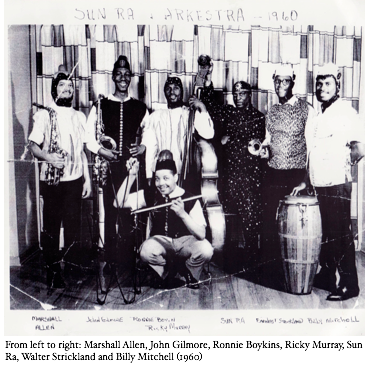
Sun Ra and his Arkestra were known, amongst other things, for their elaborate space garb – the sequins, the ancient Egyptian symbolism, the face-paint, the full-length capes. These were spacesuits the band wore to accompany them on their mission to ‘travel the spaceways.’ So when I first began the project I called The Spacesuits, the plan was to construct a series of costumes, modeled after the garments of the Saturnalian people from which Mr. Blount claimed to have descended. I drew inspiration from the early ILC Dover spacesuit prototypes, crafted in the mid-sixties. I also drew inspiration from artist and Afrofuturist Nick Cave, known for his Soundsuits, large wearable sculptures whose bedazzling feathers and contours are meant to obscure the race, class, and gender of its inhabitants.
The Spacesuits, however, quickly became more about the music than about the costumery. The Arkestra’s outfits, after all, were only subsidiary elements of a larger mission; namely, that to restore race relations by re-imagining a future for blacks that quite literally transcended space and time. Sun Ra’s music was, above all, paradise music. It was music, which by the process of “telemolecularization” (a word coined and used often by Sun Ra), would transport its listeners to another dimension.
Thus began my own search for Sonny Blount’s contemporary musical descendants. The Spacesuits became a collective of musicians in whose work I heard elements of new utopias. I studied their bodies of work and searched for themes like apocalypse, reincarnation, the afterlife, etc. To each musician, I provided five ‘calls to action.’ I gave them prompts like, “Create a short book on how to communicate with stars. Do not use words,” (a prompt given to Stasia Irons of THEESatisfaction) and “Imagine the instant the world began. Create the corresponding soundscape,” (a prompt for Bryce Hample of REIGHNBEAU). The responses produced by the musicians in The Spacesuits collective will form the basis of a series of 8+ multimedia installations over the course of The Spacesuits summer tour, which begins on April 24th at Mengi in Reykjavík, Iceland and then travels across North America. (See the full schedule here.)
When Portals did a micro-feature of Montreal-based musician Karneef in April 2014, I knew I’d want him in The Spacesuits crew. The feature was succinct, if humorous. It read:
Montreal’s Karneef is a man that really, really loves his bass. The video for his new single “Swimming” finds him in some weird situations, most of which involve him in his underwear. Karneef keeps it cool with a lot of smooth strumming and awkward dance moves; occasionally hiding behind paintings so he can scope out a cute girl in the studio. She seems to be in her own world for most of the video, walking around aimlessly and dancing while Karneef serenades her in different parts of the studio.
It is true that Philip Antoine Karneef does indeed love his bass. But he’s also up to much more. Karneef’s 2013 album Love Between Us is, for me, an exercise in paradise music. It is, of course, tongue-in-cheek, but its sincerity is just as unmistakeable. In fact, over time, it has become clear to me that paradise music always plays on that tension between irony and sincerity. One of my favorite moments in A Joyful Noise, Robert Mugge’s 1980 documentary, is when that very subtle smile appears on Sun Ra’s visage as he advocates for governments to give constitutional rights to angels. The smile isn’t signaling that Sun Ra is, in fact, joking around. Instead, the smile says, “There’s a lot more going on here than you think.”
Read Anaïs Duplan's interview with Philip Karneef after the break.
Read more →