Cuushe “I Love You”

04 Apr 2013 — Henning Lahmann

Incredibly sweet, no really sugarcoated new song by beloved berlin via Tokyo dream pop artist Cuushe, whose way too lovely "I Dreamt About Silence" kept us breathless for several weeks last summer. The gently twinkling "I Love You" continues to explore some parallel dimension where everything appears to be cute and light-hearted, though the artwork hints at something discomforting right beneath the shimmering surface: those cuddly cartoon characters look pretty exhausted, most likely just having finished a weekly meeting of Lovesick Anonymous.

"I Love You" is part of an as yet unnamed album, coming July 8 via Tokyo imprint Flau. Cuushe will perform in Berlin as part of a Flau label showcase at Antje Öklesund on April 24. RSVP here.

Read more →

Watch: Majical Cloudz “Childhood’s End”

04 Apr 2013 — Tonje Thilesen

There is so much that can be said about our dearest Canadian friends Majical Cloudz: from the very moment when Devon Welsh embraces the audience with his loving puissance, tears start to uncontrollably fall around me. Moreover, it's probably Devon as a songwriter that more accurately emphasizes the growth of their current success, as his lyrics evoke an emotional extension — a subconscious pain, that somehow feels very close and sacred to the individual listener. Myself included, of course. 

Montreal local Emily Kai Bock (who previously also directed Solar Year's "Brotherhood") decided to bring visual content to Majical Cloudz' most recent pop gem "Childhood's End", featuring Devon's father and Twin Peaks actor Kenneth Welsh as the main character. Below is a rather long, but loveingly written blog post in curtesy of Devon.

"Emily and I have known each other for a long time, going back to the days of Lab.Synthese, which was the venue she lived in and ran with Sebastian Cowan, Alex Cowan and others. I have been a fan of her video work for a long time so I was thrilled that she was interested in collaborating with myself and Matt. I have been present at two of her other video shoots (for Grimes’ “Oblivion” and Solar Year’s “Brotherhood”) so it was an unfortunate but ironic twist of fate that we were on tour during the filming of this video. As a result, some of the details of its production are a mystery to me, but it makes it all the more fascinating for me to watch. My sincere gratitude goes out to Emily, Bobby Shore and everyone else involved in the production. It’s a truly cinematic video and we are honoured to have our song as the soundtrack.

I’m also very grateful to have a video that features my father Kenneth Welsh, who is a very accomplished actor and who has spent decades acting for the stage, film & television. His career has been a long one but you may know him best from the television show Twin Peaks. His performance in the video is very moving and I’m mostly just really happy to be able to collaborate with him in some way (this is not the first time he has collaborated with Majical Cloudz, as he played the flute and trumpet on two early recordings back in 2010)."


Read more →

Aristophanes “桃 The Peach Blossom”

03 Apr 2013 — Kelsie Brown

Aristophanes is a young MC based out of Taipei, Taiwan. Although none of her verses are in English (and instead Mandarin Chinese), her flow is buttery smooth and full of emotion. The Peach Blossom is a retelling of a classic Chinese and Japanese story. Aristophanes states, 'In my version there is a person who always dreaming about a place called 桃花源. After a long walking, he finally arrives there. But everything is ruined when he arrives. So his dream is shattered.' (via Soundcloud). With this in mind, and with the intense production courtesy of talented Japanese producer Lidly, The Peach Blossom becomes a dramatic tale of sorrow and heartbreak.

Stream 桃 The Peach Blossom (prod. by Lidly) below, and listen to more Aristophanes on her Soundcloud.

Read more →

Interview: Sister Crayon

03 Apr 2013 — Ashley Canino

Sister Crayon is the Oakland-based duo of Terra Lopez and Dani Fernandez. After their debut in 2011, Bellow, and a lot of touring last year, the two spent last fall recording their follow-up Cynic. The five-track EP is a confessional piece, approaching topics most personal to both members. Ahead of the release, we talked with the duo about the experience of creating Cynic and a look at what is next.

Cynic is out April 16 via Fake Four Inc.

Read more →

Cynic, as its name implies, is a lot darker than Bellow. Did you set out to make a grittier EP or did the subject matter just take you there?

Terra: We went through some really tough times and situations while writing and recording this EP. I knew before it even began that the EP was going to be dark, that it was going to be heavy, and that because of that, that our new work would be a lot more honest and a lot more serious than Bellow. Over the last two years since Bellow was released, so much has happened in our individual lives as well as with our music. It was a really exhausting, frustrating, overwhelming time and I think the songs were written because they needed to be. I clung to these songs in order to get through the day, some days.

Was there any discomfort for either of you in composing and recording such a revealing album? [For Dani] What was it like creating around an experience that wasn't necessarily your own?

Terra: There was an urgency in writing this record that I had never personally experienced before. I was unafraid of being brutally honest with myself, about my family, etc. I knew that I had things to get off my chest, experiences I needed to find some closure in and I used this opportunity to do that as best as I could. When writing "Meager Leavings", the lyrics just flowed out in one sitting. That usually doesn't happen for me but I think it needed to get out. I tracked the vocals in one take (during pre-production) and sat back and sighed in relief. Now, looking back at it I feel somewhat anxious about others hearing this track in particular but at the same time, I'm relieved because I want to be able to be completely open like this. I want people to relate if they can-and if they can't, to at least know that I'm just trying to get through the day like the next person.

Dani: I think "Meager Leavings" was the most honest song we had ever written. I was really taken back with how honest Terra was being but at the same time I loved it because that's how I want all of our songs to be. I want our audience to connect with us on a real level and to maybe relate to what we have been through and/or still going through.

What was your approach to incorporating both live and electronic instruments?

Terra: Dani and I really wanted to focus this time around on beats, sub bass, and vocals. We knew that we wanted to focus on having a good balance of live drums (via Omar Barajas) along with heavy MPC and SPD beats (via Dani). We wanted the beats to be the most important musical element on this record so we took a lot of time with that. Our producer Wes Jones did such an incredible job understanding how to balance the live and electronic aspects and make the songs as dynamic as possible. I wanted this record to be a raw representation of how our live show is – intense and heavy. I want people to feel what's going on on this recording.

Can we expect the full-length due out late this year to be as heavy, in topics and sound, as the Cynic EP?

Terra: I'm really looking forward with the full length to explore more in vocal dynamics and with electronic beats. We are leaning more towards the electronic aspect for the full length because it's something we have always wanted to do and I'm really excited to explore that realm with our producer. I really want to get lost in sound and focus on vocal melodies, harmonies, etc. As far as heavy topic material, I'm not sure. I do tend to write when I'm going through shit but I'm really going to try to challenge myself and not be afraid to write some lighter material. That will be my challenge to myself-hold me to it!

Will you spend a good part of 2013 touring? Are there any particular shows you're excited for?

Terra: You know, we spent most of 2012 touring so we will be playing dates to support the EP release but I think our main focus will be writing and recording the full-length. We love playing live so we will play as much as possible but I'm already thinking of the full length and how we can make that happen as soon as possible.

I'm really excited to share the stage with Shlohmo and Jeremih on April 5 in San Francisco  and we are also putting together some West Coast dates for the EP release. I can't share just yet!

Have other Bay area artists influenced the way your sound has developed?

Terra: We are still pretty new to the Bay Area so I'm not sure if I would say that any artists from here have influenced our sound but the area and our neighborhood where we live sure has. Living in Oakland, we are challenged and exposed to so many different elements and people. I defintely think living here will have a huge influence on us musically-maybe lyrically. Living here has enabled us to hide out and work on music every day though. We still don't know too many people here so we haven't gone out much. I do have to shout out to Dose One, Jel, and Odd Nosdam though. They have influenced me for years and they all live out here.

Preview: Mystica Tribe “Flowers / Stars Are Mine”

03 Apr 2013 — Henning Lahmann

Still largely and undeservedly overlooked by most, Tokyo's Taka Noda, who since 2010 records as Mystica Tribe, is about to drop not one but two follow-up records to his remarkable 2011 debut Meditation Stick. Again released by Rotterdam-based imprint Syncom Data Records, the EPs Flowers and Stars Are Mine both continue to delve deep into dub-heavy territory, with techno-leaning compositions that give a lot of weight to bass while leaving enough space for every single element within the arrangement to breathe. The textures exude a somewhat exotic feel, though it is unclear if that is due to the listener's preconception of dub, the knowledge of the artist's origin, or simply the occasional, eponymous tribal beats that break up the tracks' basic grid. All along, the music's otherness remains elusive and hard to really attribute to a particular place: Mystica Tribe's music will send you off on a trip, but the destination remains obscure.

The Flowers EP is out already, Stars Are Mine arrives May 7. Order Flowers now via Clone Records. Stream snippets of both EPs below.


Read more →

CTM and Diversity: An Unprovoked Rejoinder

03 Apr 2013 — Henning Lahmann

In his account of last month’s CTM festival, published two weeks ago, author Warren O’Neill originally had included the following paragraph:

However, one cannot talk about this year’s CTM without mentioning the distinct lack of female artists. Over the course of the whole week, I saw only three women performing, and though for sure there were female artists I wasn't able to see even including those, I’d be surprised if it reached double figures. Of course some might argue that this is a problem of the experimental music culture at large and that the blame shouldn't be put on organisers (Considering that just about everybody’s label of 2012, Berlin-based PAN, has had only two women on its 40-strong roster, both as a part of a male-female duo, lends some weight to this point of view). But due to the theme of the festival you would think they’d have done a better job. The same can be said of other aspects of diversity; and for a festival aiming to be ‘full of contrasts’, rather disappointingly it was composed mainly of white males in their 20s and 30s coming from Western Europe or North America.

Read more →

After some back and forth with both Warren and Jan Rohlf, CTM Festival’s main curator (before someone feels inclined to point out the obvious irony: yes, male white dudes in their 20s and 30s from Western Europe discussing the topic), I eventually decided to remove the paragraph during the editing process. Not because I believe the assertions to be incorrect or not justified. In fact, most readers will be aware that the observations are in themselves not exactly new. Shortly after the end of the festival, Berlin’s BarbNerdy sparked some discussion and indeed some outrage with a post on her blog that initially counted only one performing female artist during CTM, before eventually settling the figure at six. Despite that uncertainty, the DJ/writer’s rage was voiced in unambiguous terms. "We have 2013 and you really make us to bring up the mad discussion about ‘do we need a quota?’ again. I’m against it. (…) But If you do not start digging deeper and check out the fantastic female musicians out there (…) [then] we need a quota just to gain more attention." The intervention was backed up with some bare facts by the website female:pressure, a self-described ‘international database and support network of women in the fields of electronic music and digital arts’. Numerically assessing various global festivals of recent date, female:pressure came up for CTM with a total of 18 female and seven mixed artists/projects. At the same time, 153 male musicians performed at the festival, alongside three of ‘unknown’, or probably rather undetermined, gender. A perplexing figure indeed.

So what about Warren’s assessment then? When confronted with his critique, Jan Rohlf, while admitting that it "surely would have been good to have more female musicians" at the festival, pointed not only to common organisational restraints – such as past bookings, other Berlin bookers’ recent activity, theme, current productions, financial capabilities, availability of artists, conception of individual programme items – and CTM’s more favourable record in this regard, with past editions of the festival itself but also considering the organisation’s numerous other activities over the course of a year. He also compared the Berlin festival’s lineup with that of other thematically similar events, in particular last October’s edition of Krakow’s Unsound Festival, which by his own account did not feature a higher proportion of female artists. This impression is in fact supported by female:pressure’s findings. While CTM ‘at least’ exhibits a ratio of 16.3 percent female musicians, Unsound hits at a mere 12.6. The conceptually akin Mutek Espagne and Mutek Montreal come in at 8.3 and 17.9, respectively.

However, insisting on the latter clarification, what Jan Rohlf stressed first and foremost was the overall situation of society, emphasizing the point already conceded by Warren as well: there simply are fewer female electronic musicians than male, which necessarily leads to a lower presence of women performing at electronic music festivals. And for sure, at first glance it appears difficult to escape the argument’s validity. Asked about her opinion, UK-based journalist Steph Kretowicz, whose own apt take on the festival week can still be found over at Dummy, concurred. "I think the problem of representing women in electronic music is much more complicated than placing an onus on a festival organiser to fill some kind of ‘quota’. The fact is, there are fewer women working within the electronic arts. In the same way that there are fewer women journalists and fewer women construction workers – it’s simply a reflection of the systems of society at large. This is an issue, not only of opportunity but of conditioning. We still exist in an extremely gendered, patriarchal society and those people, defined as women, are not encouraged to excel in traditionally masculine fields. That's not to mention issues of ‘raced’ artforms, which I think is also crucial for analysis. As Holly Herndon said, when asked about being one of few women appearing to take part in artist talks at CTM, ‘it’s not just not women’." And it surely isn’t just festivals: Looking at this very website, I would be surprised if an actual numerical evaluation would not bring to light figures somewhere close to female:pressure’s findings, despite the fact that both our favourite album of 2012 and our favourite track had been produced by female electronic artists. Artists, by the way, who were both present at CTM, a fact that’s somewhat telling I suppose.

Strikingly, in his response Jan Rohlf pointed to an essay by pansexual/transgender artist Terre Thaemlitz aka DJ Sprinkles entitled "Statement of Purpose. Identifying Social Content in Japanese Electronic Music", included in the anthology Gendertronics. Der Körper in der elektronischen Musik [The Body in Electronic Music, ed.], edited by club transmediale and published by Suhrkamp in 2004. Thaemlitz basically arrives at the same conclusion, while furthermore asserting that "[o]ne of the keys to developing and spreading practices on a wide-scale basis is wide-scale necessity. But frankly speaking, the fundamental assumption that there is a necessity for more (white?) women producers of electronic music (not to mention transgendered producers) imbues electronic music with a degree of cultural importance that (…) I ultimately find lacking". Eventually, she even "dare[s] to suggest there are some cultural spheres in which ‘equal representation’ will never exist on a material level".

So is that it? No doubt – I do agree that curators of contemporary music festivals are not the first ones to blame when it comes to the blatant lack of woman artists present at those occasions, which is why both Warren’s initial review and BarbNerdy’s piece might come across as slightly unfair to those directly involved in the organisation of a festival as complex and challenging as CTM. And I also don’t really believe in any sort of actual conspiracy to preserve male dominance at the event, as suggested by BarbNerdy. If anything, what the festival revealed last month was the need for a discussion that’s still to be started. Still, I also wonder if it is that simple the other way round, too.

However, I’m not so sure if I can agree that we should accept that ‘culture’ might simply not ‘need’ more non-male electronic musicians, as Thaemlitz bluntly asserts. That would essentially entail asking already active woman producers to basically accept the fact that they probably will continue to not be booked in the future. Quite the contrary, I wonder why we don’t assume the possibility that festival booking could actually make a crucial difference insofar as an increase of female artists at such much-noticed public events may set an example that could in itself encourage more women to get into electronic music, or to put their stuff out there, or getting more labels to sign them. Why not, instead of relying on a bottom up conjecture and just continue with the assumption that once there are ‘enough’ women in electronic music, booking will follow suit automatically, why not just as well suggest that what we should establish in fact is the exact opposite. After all, it is not really ‘the women’ – or, rather, the whole non-western white male part of the population – who somehow need to step up and ‘emancipate’. If the ideas of enlightenment ever meant anything, it surely is that society at large that is in urgent need of progression. And when it comes to avant-garde pop culture, I wonder if music festivals couldn’t play a much more significant role in attempting to achieve that than they seem ready to admit.

For now, I’m unsure if the talk about quotas will lead anywhere ultimately; so I’m not willing to advocate them here and now. But if the real issue is a question of conditioning, as Steph suggests, why not start conditioning society by means of progressive booking and journalistic coverage? In other words, where should that necessary and anticipated change come from if not through those who write about electronic music or organise music festivals? If perceived correctly, forward-thinking curatorship in whatever field shouldn’t be the conclusion of socio-cultural shift, but stand firmly at its outset. It’s not called avant-garde for nothing. So for what it’s worth, maybe we should just all try a little harder next time – because it seems to me that The Golden Age is still a long way off.

Bobby Browser “Baby Dre”

02 Apr 2013 — Kelsie Brown

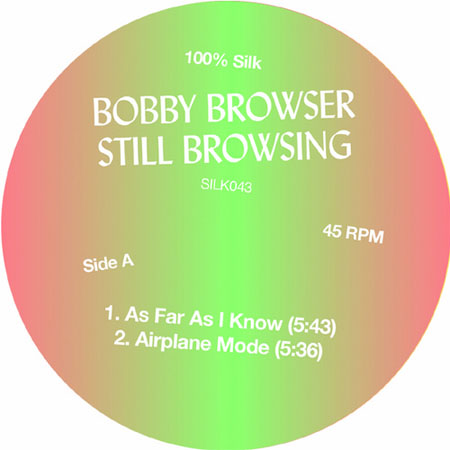
Oakland-based artist Andre Ferreira makes icy house jams as Bobby Browser. His new EP, Still Browsing, showcases four downtempo dance tracks. EP highlight and closing track "Baby Dre" incorporates smooth, easy-listening sounds over deep house beats, bringing to mind new age artists of the early nineties.

Still Browsing 12" is out April 2 (today!) via 100% Silk.


Read more →

Tuff Sherm “Idle Engines”

02 Apr 2013 — Henning Lahmann

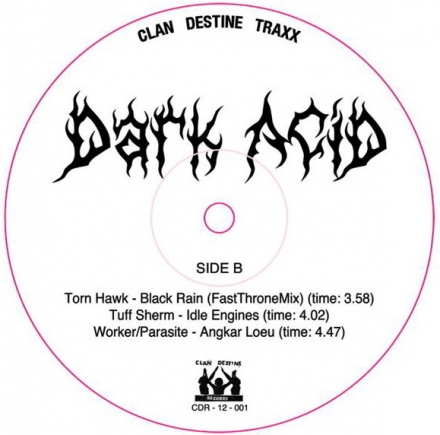
Dark Acid is the first in a series of 12" records that explore the shadier corners of the dancefloor, a new direction that is quite surprising for UK goth/cold wave/leftfield/weirdo pop imprint Clan Destine Records. Sold under the name 'Clan Destine Traxx' and coming in strictly limited editions of 250, the concept appears to aim at more classically indebted yet resolutely autonomous electronic music explorations of both under-the-radar and already more or less established artists. Dark Acid features tracks by Dungeon Acid, Ron Hardly, Luke Wyatt aka Torn Hawk, Worker/Parasite, and Australian producer Eugene Hector aka Dro Carey, here once again operating under his Tuff Sherm guise. Listen to the latter's contribution "Idle Engines" below, a slow-burning, reductionist acid assault.

Order the Dark Acid 12" now over here. The release date is May 6.

Read more →